

Hi there,
I break down top LinkedIn posts so you can craft content that resonates.
What’s hot this week: OpenClaw is still trending. More and more people are posting tips and use cases for creating LinkedIn content with it.
OpenClaw is the most advanced AI assistant framework, and you can try it without code using this 1-click setup on ClawPlane.
In this issue, you’ll find:
The 3 high-performing LinkedIn posts this week
The 13-Step Warm Outreach System (How to Never Send a Cold DM Again)
The 3 high-performing posts this week
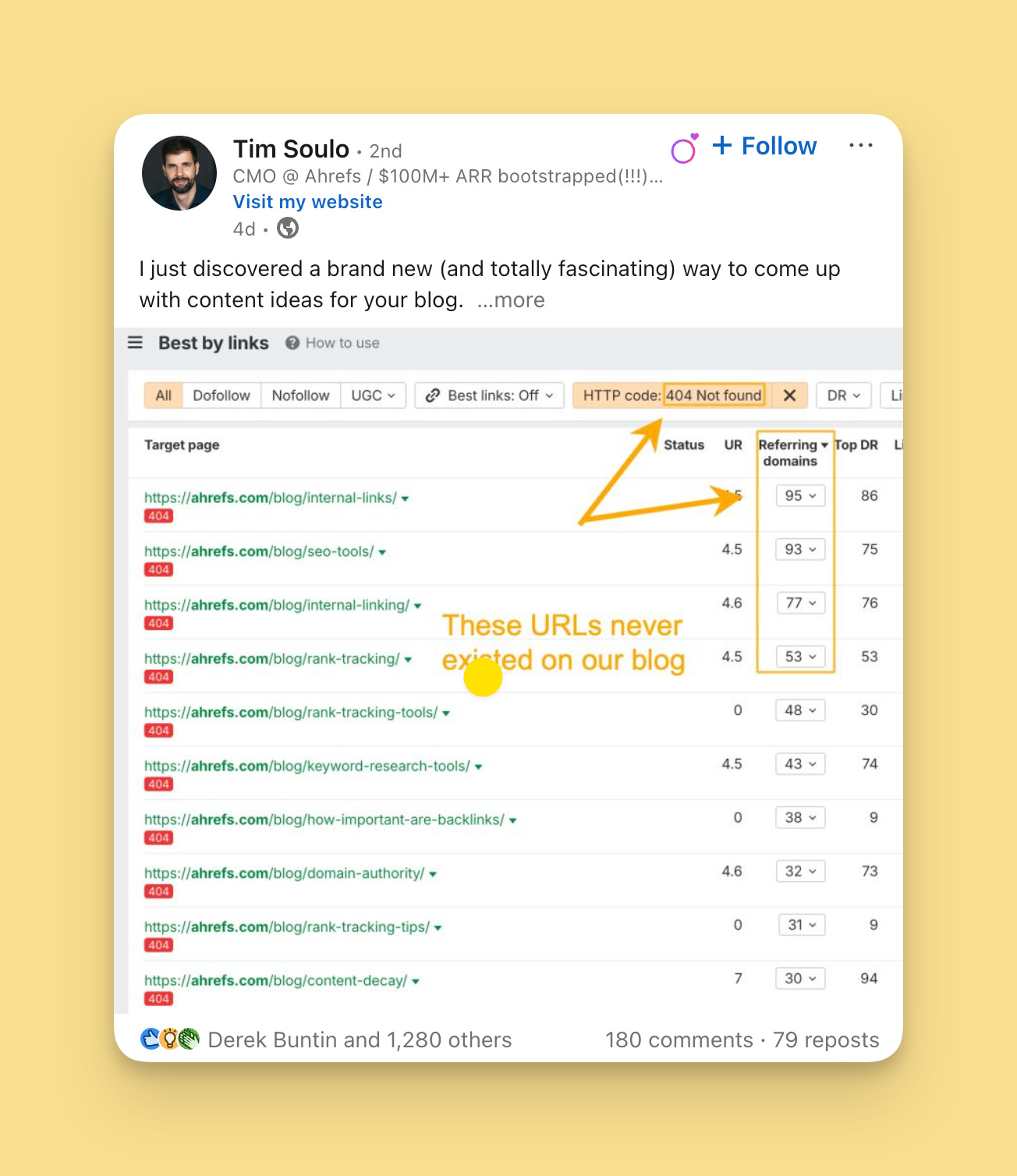
1. I just discovered a brand new (and totally fascinating) way to come up with content ideas for your blog.
Why this post?
This post went viral, receiving 1,280 likes in 4 days. It received 9-55 times more reposts than other Tim’s posts this week.
WHY THIS POST WENT VIRAL
This post turns an AI failure (hallucinated links) into an SEO opportunity. It’s a genuinely novel insight that most marketers have never considered.
BREAKDOWN
Discovery hook: “I just discovered a brand new (and totally fascinating) way to come up with content ideas” - promises novelty
Unexpected answer: “It’s your 404 pages. (Stay with me...)” - weird enough to keep reading, asks for trust
Story setup: Randomly checked if Ahrefs Blog had 404s with backlinks - shows authentic curiosity
Surprising find: Hundreds of them - stakes raised
Plot twist: “None of it was ever alive” - URLs never existed, all hallucinated by AI
Explains the phenomenon: AI-generated articles link to URLs that don’t exist because AI “thinks” they should
Mind-blown reframe: The hallucinated URLs actually reveal content gaps - AI is accidentally doing content research
Actionable insight: “We’re going to publish articles on all these topics and turn hundreds of broken hallucinated links into real backlinks”
TRY THIS
Frame discoveries as stories - “I randomly checked...” feels more authentic than “Here’s a hack”
Use “stay with me” when your idea sounds weird at first - it buys you trust
Show your thought process including the “mind-blown” moment - let readers experience the discovery with you
Give the exact steps to replicate - no vague advice
TOGETHER WITH POSTHERO
Grow your audience faster on LinkedIn. With an AI-powered tool that helps you create content and grow on LinkedIn.
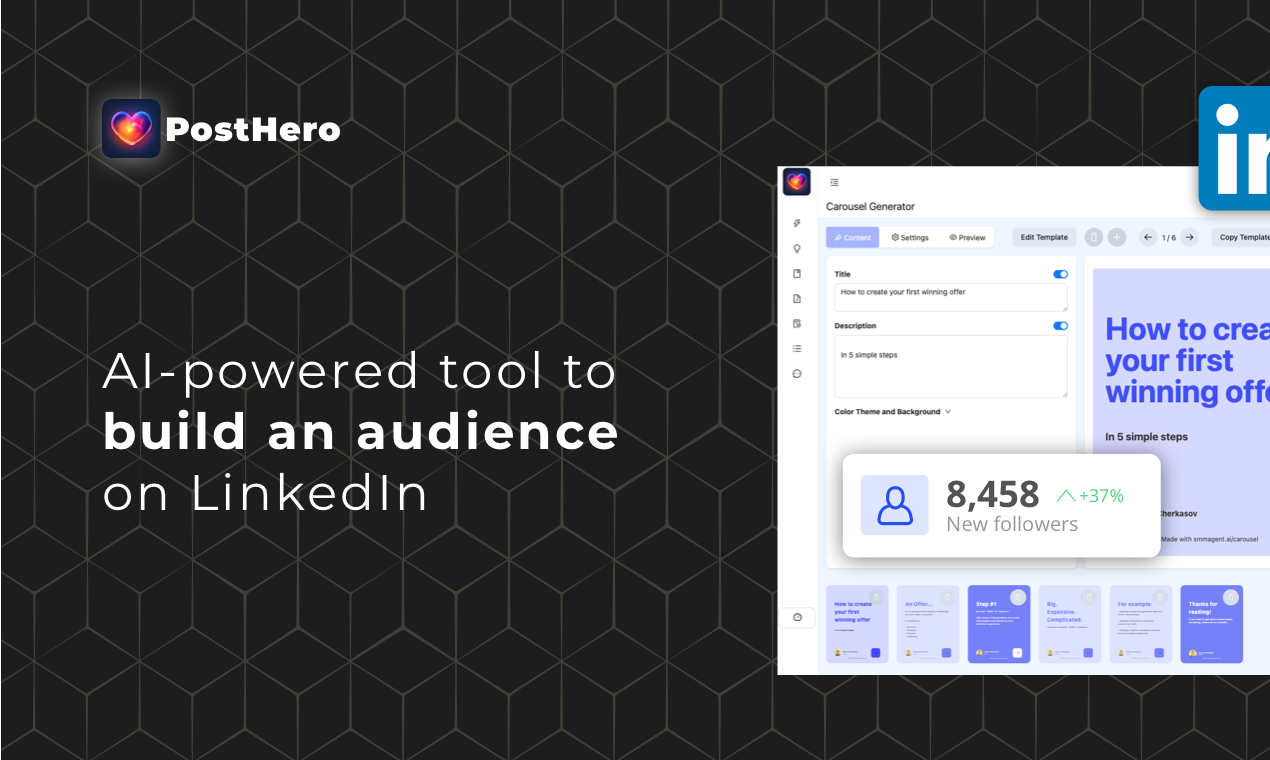
Create high-converting content that helps you grow on LinkedIn
Create a weekly content in 76 seconds
AI Voice assistant for creating content in seconds
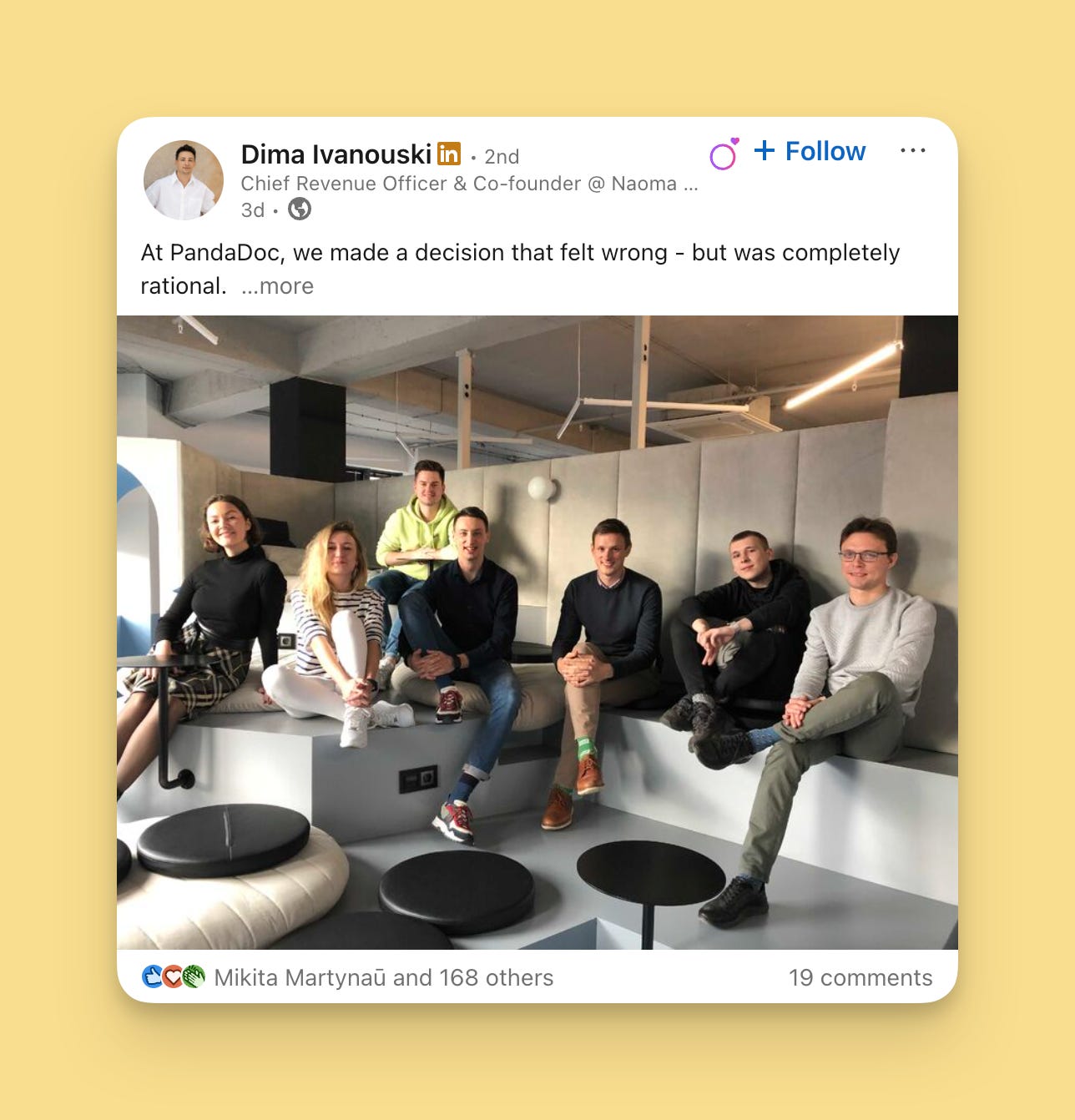
2. At PandaDoc, we made a decision that felt wrong - but was completely rational.
Why this post?
Another post that went viral this week - it got 168 likes in 3 days and performed 10 times better than Dima’s previous content.
WHY THIS POST WENT VIRAL
This post works because it turns a painful business trade-off into a founder origin story.
BREAKDOWN:
Tension hook: “A decision that felt wrong - but was completely rational” - creates immediate curiosity about what happened
Introduces the conflict: As company grew, the math became impossible to ignore - cost of human sales couldn’t justify small contracts
Shows the hard decision: Raised sales-assisted threshold, pushed small companies to self-serve
Reveals the painful outcome: Conversion rates dropped, churn increased, no cost-effective way to close the gap
The nagging feeling: “But it kept bothering me“ - signals this story isn’t over
Introduces the solution: Naoma AI - an AI sales agent that can have that conversation for every segment, at any hour, in any language
TRY THIS
Start with a decision that created internal conflict - “felt wrong but was rational” is a powerful tension
Tell a specific story from a previous company to explain why you’re building what you’re building now
Show the real business trade-offs: math, thresholds, what you sacrificed
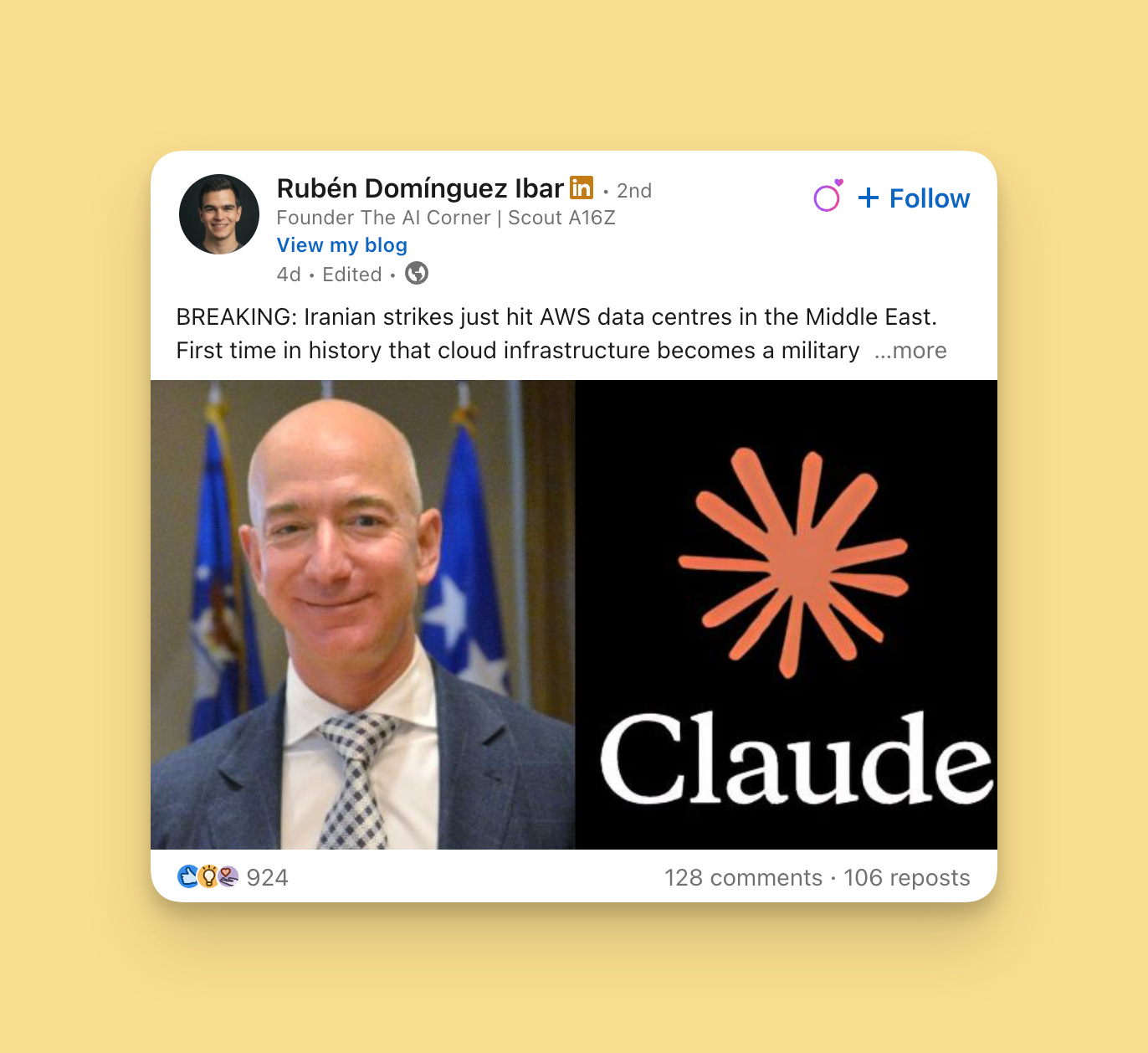
3. BREAKING: Iranian strikes just hit AWS data centres in the Middle East. First time in history that cloud infrastructure becomes a military target
Why this post?
This post got 1.5-150 times more comments than Ruben’s other posts this week.
WHY THIS POST WENT VIRAL
This post newsjacks a major geopolitical event and reframes it for a tech/AI audience.
BREAKDOWN:
Breaking news hook: “BREAKING: Iranian strikes just hit AWS data centres“ - urgent, immediate, demands attention
Historic framing: “First time in history that cloud infrastructure becomes a military target” - elevates the significance
Quick bullet facts: Objects struck, zones lost power, AWS failover instructions - fast, scannable updates
Expands the scope: Alphabet, Microsoft, Alibaba also have facilities there - shows this isn’t just an AWS problem
Market signals: US futures down, oil up, gold up - adds financial stakes for business audience
Provocative question: “What happens when the cloud stops being safe?” - makes readers think bigger
TRY THIS
Jump on breaking news fast and reframe it for your specific audience - find the angle others missed
Use “BREAKING” and “first time in history” sparingly but effectively for truly significant events
Connect dots that aren’t obvious - military strikes → cloud infrastructure → AI dependencies
Add market signals (futures, oil, gold) to make business audiences pay attention
LinkedIn Guide
The 13-Step Warm Outreach System (How to Never Send a Cold DM Again)
I hate cold DMs.
You know the ones.
“Hey, I help founders like you 10x their revenue. Want to hop on a call?”
Delete.
“Hi! I noticed your profile and thought we could collaborate.”
Delete.
“Hey Anton! Quick question for you...”
It’s never a quick question. Delete.
Cold outreach feels gross. For the sender and the receiver.
But here’s the thing: DMs actually work. They’re one of the best ways to start conversations and land clients on LinkedIn.
The problem isn’t DMs. The problem is sending them cold.
What if every DM you sent was warm?
What if people already knew who you were before you reached out?
What if they were actually happy to hear from you?
That’s what the Warm Outreach System does.
No cold messages.
No pitchslaps.
No desperation.
Just real conversations with people who already recognize your name.
Let me show you how it works.
Why Cold Outreach Fails
Cold outreach has a fundamental problem.
There’s no trust.
You’re a stranger. They don’t know you. They don’t know if you’re legit. They don’t know if you can actually help them.
So they do the safe thing: ignore you.
It doesn’t matter how good your offer is. It doesn’t matter how personalized your message sounds. If they’ve never seen your name before, you’re fighting uphill.
The math is brutal.
Cold outreach: 1-3% response rate. Warm outreach: 20-40% response rate.
Same message. Completely different results.
The difference? Familiarity.
The Warm Outreach Formula
Here’s the system in one line:
Familiarity → Filtering → Permission → Trust → Client
Before you ever send a DM, you need to be familiar. They should have seen your name. Your face. Your content. Your comments.
Then you filter for the right people. Not everyone. Just your ideal clients.
Then you ask for permission to continue the conversation. No pitching. No assuming.
Then you build trust through real conversation.
Then, and only then, some of them become clients.
This takes longer than blasting 100 cold DMs. But it actually works.
The 13-Step Warm Outreach System
Here’s the exact process.
Step 1: Start With Familiar Faces
Most people reach out to complete strangers.
That’s why “selling” feels odd. There’s no trust.
Flip it.
Focus on people who have already interacted with you:
People who liked your posts
People who commented on your content
People who viewed your profile
People who sent you a connection request
People you’ve engaged with in comments
These people already know who you are. The conversation starts warm.
Step 2: Filter for Engagement
Not everyone who engages with you is a potential client.
You need to filter.
Look at who’s engaging with your content. Check their profiles. Do they match your ideal client profile?
If yes, add them to your list.
If not, appreciate the engagement and move on.
You’re not trying to DM everyone. You’re trying to DM the right people.
Step 3: Match Your ICP
Get clear on who you’re looking for.
Your Ideal Client Profile should include:
Job title or role
Industry or niche
Company size
Pain points they have
Goals they’re trying to achieve
When someone engages with your content, check if they fit. If they do, they go on the list.
This is filtering in action. Quality over quantity.
Step 4: Feed Into Your CRM
Track your potential leads somewhere.
This can be a simple spreadsheet. Or a tool like LinkedIn Sales Navigator.
For each person, note:
Their name and profile link
How you found them (liked a post, commented, etc.)
Where they are in the conversation
Any relevant details from their profile
You can’t keep this in your head. You’ll forget. Track it.
Step 5: Become “Top of Mind”
Before you DM someone, warm them up.
How?
Show up in their world.
Comment on their posts
Reply to their comments
Like their content
Engage with them publicly
Do this for a few days or a week before reaching out.
When you finally DM them, they’ll think: “Oh, I’ve seen this person around.”
That’s familiarity. That’s the warm-up.
Step 6: Attract Profile Views
Every profile view is a warm signal.
When someone views your profile, it means they’re curious about you. They want to know more.
That’s an invitation to reach out.
You can now send a DM like:
“Hey, I noticed you checked out my profile. Thanks! Curious what brought you here?”
That’s not cold. That’s responding to interest.
To get more profile views:
Post consistently
Comment on relevant posts
Engage with your ideal clients’ content
Your activity drives profile views. Profile views give you warm DM opportunities.
Step 7: Send DMs Daily
Make this a daily habit.
Not 100 DMs. Not spamming.
5-10 thoughtful DMs per day to warm leads.
That’s it.
Yes, it feels angsty at first. Yes, you’ll feel weird.
Do it anyway.
The more you do it, the easier it gets. I promise.
Step 8: Never Pitch in the First Message
This is where most people blow it.
First message = start a conversation. That’s all.
Not: “Hey, I help founders 10x their revenue. Here’s a link to book a call.”
Yes: “Hey Sarah, saw you liked my post on LinkedIn outreach. Curious, is that something you’re working on right now?”
Open-ended. Conversational. No pitch.
You’re not trying to sell in message one. You’re trying to start a dialogue.
Step 9: Follow the PBS Psychology
PBS = Permission-Based Selling (more about it here).
The rule is simple: never assume they want something. Always ask first.
“Would it be okay if I shared an idea?”
“Mind if I send over a quick suggestion?”
“Would you be open to a short call to explore this?”
Every step is an invitation. Not a demand.
If they say no, you stop. No guilt trips. No follow-up pressure.
This builds trust. People feel in control.
Step 10: Separate DMs Into Folders
As you have more conversations, things get messy.
You’re talking to leads, clients, collaborators, random connections.
Use a tool like Kondo to organize your inbox.
Create folders:
Warm leads
Active conversations
Follow-up needed
Clients
Networking
This keeps you sane. You’ll know exactly who to message and when.
Step 11: Set Follow-Up Reminders
People don’t always reply immediately.
That doesn’t mean they’re not interested. They’re just busy.
Set reminders to follow up.
If someone doesn’t reply after 3-4 days, send a gentle nudge:
“Hey, just floating this back up. No pressure either way!”
Sometimes people need a reminder. Don’t take silence personally.
But also: if they don’t reply after 2 follow-ups, let it go. Move on.
Step 12: Track Progress
Your outreach should be measurable.
Track:
How many DMs you sent this week
How many responses you got
How many conversations turned into calls
How many calls turned into clients
This shows you what’s working. And where you’re losing people.
You can’t improve what you don’t measure.
Step 13: Feed Back Into Your Network
A lead that says “No” today isn’t “No” forever.
Their situation changes. Their needs evolve. Their budget frees up.
Keep them in your network. Keep showing up in their feed. Keep engaging with their content.
When they’re ready, you’ll be top of mind.
The system is a loop. Not a one-time blast.
Familiarity → Filtering → Permission → Trust → Client → Back to Familiarity
Why This Works
Three reasons:
1. No more cold starts.
Every conversation begins warm. They already know your name. They’ve seen your content. They recognize your face.
2. No more sleazy pitches.
You’re not pushing. You’re inviting. You’re asking permission. It feels good for both sides.
3. No more wasted time.
You’re only reaching out to qualified people. Not spraying and praying. Every DM is targeted.
Your Homework
This week, try this:
Make a list of 10 people who engaged with your content recently.
Check their profiles. Do they match your ICP?
For the ones who fit, engage with their content for a few days.
Then send a warm DM. No pitch. Just start a conversation.
Track everything in a simple spreadsheet.
See how different it feels.
No more cold outreach. No more being ignored.
Just real conversations with people who already know who you are.
That’s it for this week.
If you try the Warm Outreach System, reply and let me know how it goes. I’d love to hear what conversations you start.
See you next time.
That’s a wrap for today.
See you next week! If you want more LinkedIn tips, be sure to follow me on LinkedIn (link).
If you love this episode and want to support us, spread the word about us by sharing The LinkedIn Secrets with colleagues. I really appreciate it!
Thank you for reading!
What’d you think of today’s edition?
Help me to understand what you think about this episode. Just reply with a number (1, 2, or 3) to this email.
1 - Damn good
2 - Meh, do better
3 - You didn’t cook it
Your compadre,
Anton “LinkedIn growth strategies” Cherkasov