

Hi there,
I analyze top LinkedIn posts to help you create content that truly connects
In this issue, you’ll find:
The 3 high-performing LinkedIn posts this week
LinkedIn content that books meetings: 5 post formulas that work
The 3 high-performing posts this week
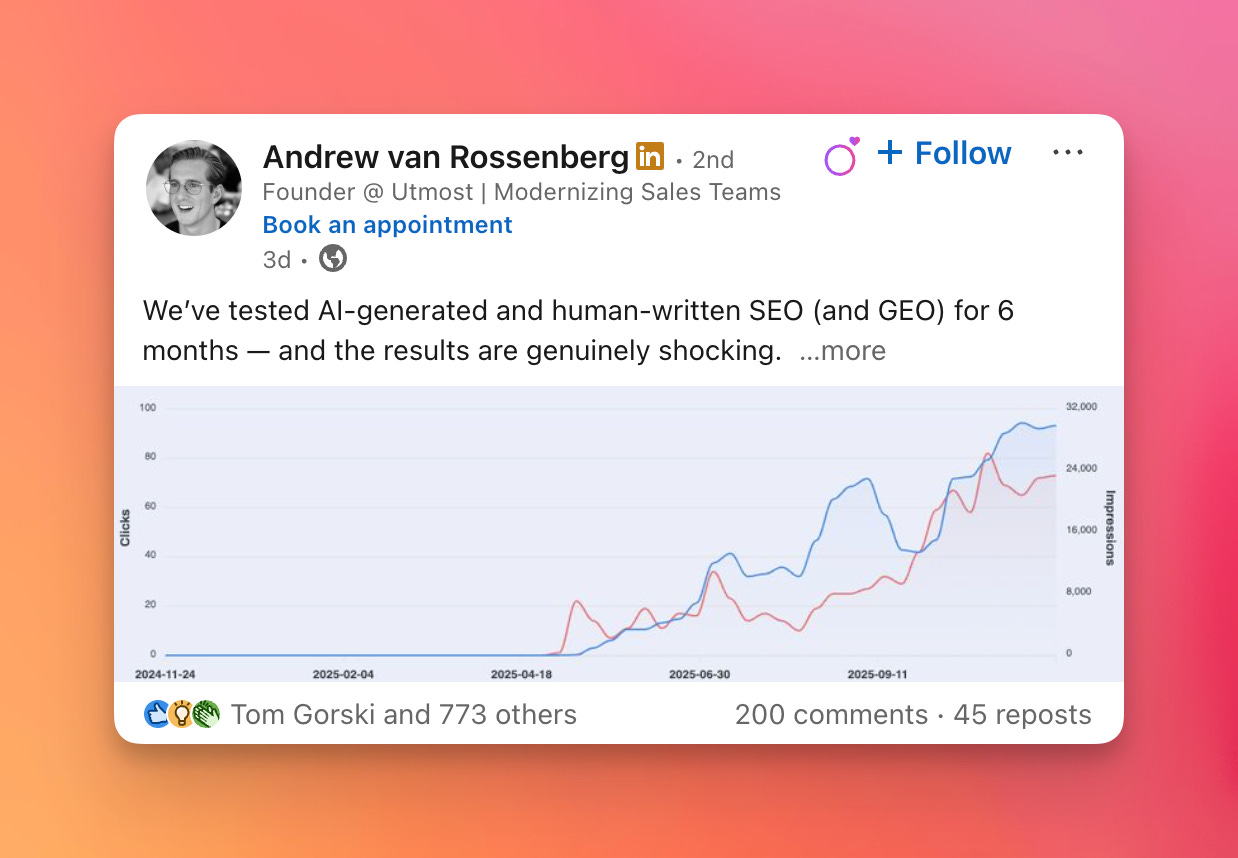
1. We’ve tested AI-generated and human-written SEO (and GEO) for 6 months — and the results are genuinely shocking.
Why this post?
This post went viral, receiving 774 likes in 3 days. It received 60 times more engagement and views than Andrew’s posts this month.
WHY THIS POST WENT VIRAL
This post hits a nerve. Everyone in marketing is wondering if AI content actually works - and Andrew ran the experiment and showed receipts.
BREAKDOWN
Hook with tension: Opens with a 6-month test and promises “shocking“ results - makes you want to know what happened
Sets the scene: Tells you they started from 0 (no visitors, no content) so you understand the stakes
Clear test setup: 28 human articles vs 192 AI articles - simple comparison anyone can follow
Drops the bomb: Shows the huge gap (722 clicks vs 9 clicks) — this is the “wow” moment
Adds a real-world proof: People who book meetings always mention the human-written posts
Visual proof: Includes a chart that makes the difference impossible to ignore
TOGETHER WITH POSTHERO
Grow your audience faster on LinkedIn. With an AI-powered tool that helps you create content and grow on LinkedIn.
Create high-converting content that helps you grow on LinkedIn
Create a weekly content in 76 seconds
AI Voice assistant for creating content in seconds
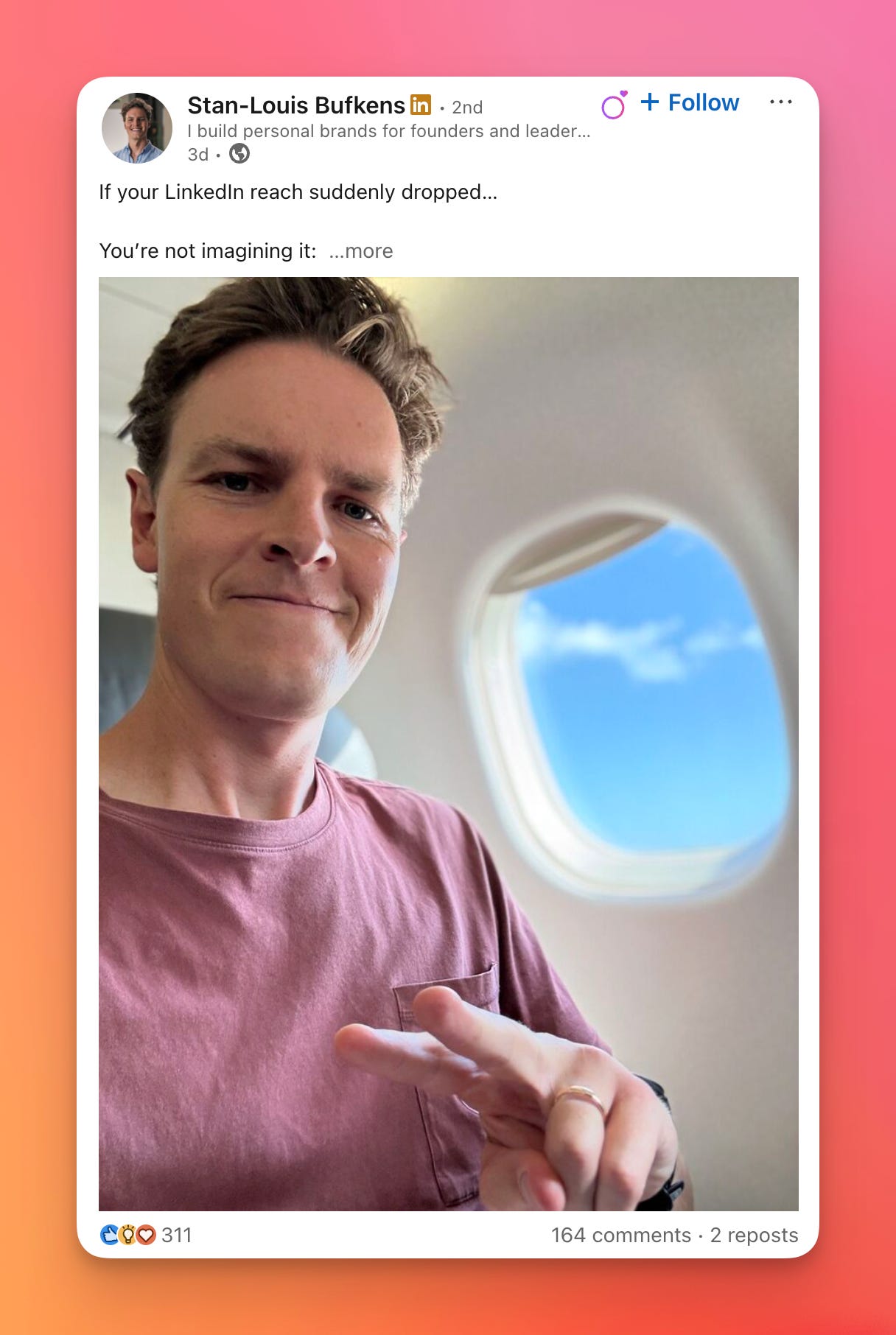
2. If your LinkedIn reach suddenly dropped…
Why this post?
Another post that went viral this week—it got 311 likes in 3 days and performed 18 times better than Stan-Louis’s previous content.
WHY THIS POST WENT VIRAL
A lot of creators on LinkedIn have noticed their reach dropping and been frustrated about it. This post says out loud what people are thinking but can’t prove.
BREAKDOWN:
Hook that validates a pain: Opens with “If your LinkedIn reach suddenly dropped...“ - speaks directly to something people are worried about
Instant reassurance: “You’re not imagining it” - makes the reader feel seen and sane
Names the villain: “LinkedIn wants you to pay now” - gives people something to blame
Explains the pattern: Shows this isn’t new - Meta, TikTok, now LinkedIn all do the same thing (give reach, then take it away)
Gives simple advice: Three easy things to do instead (behind-the-scenes, teach, keep going)
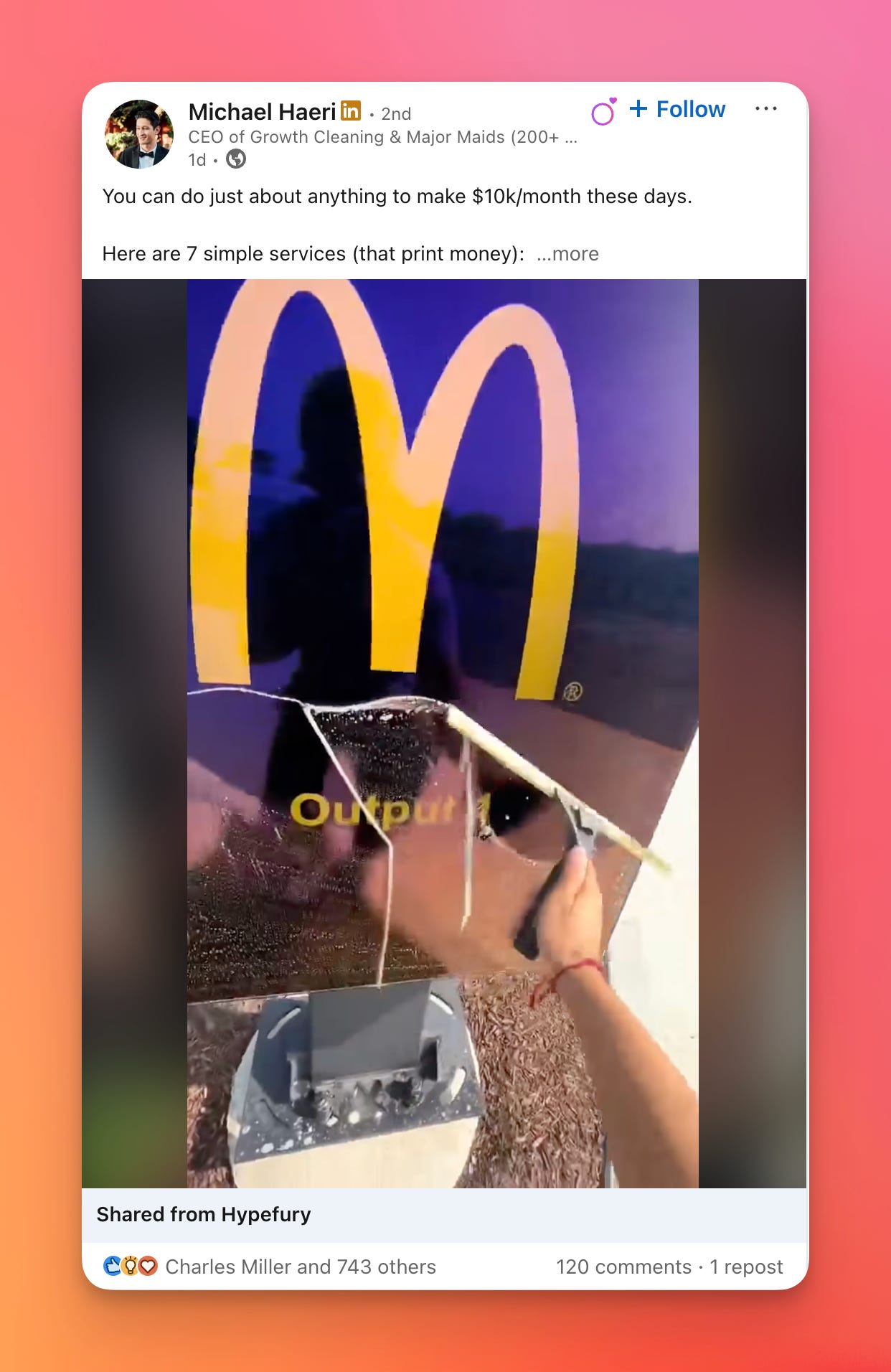
3. You can do just about anything to make $10k/month these days.
Why this post?
This post got 1.5-28 times more comments than Michael’s other posts this week.
WHY THIS POST WENT VIRAL
This post makes money feel easy and boring businesses feel exciting.
BREAKDOWN:
Bold opening claim: “You can do just about anything to make $10k/month“ - makes money feel accessible, not hard
Numbered list promise: “7 simple services“ - people love lists, and “simple” lowers the barrier
Repeatable structure: Each service follows the same format - what it is, why it works, then 3 benefits
Picks unsexy businesses: Sign cleaning, graffiti removal, parking lots — these feel doable because no one’s talking about them
Highlights hidden demand: Points out things like “businesses HAVE to do it” or “required by law” - shows guaranteed customers
Adds personal proof: Says he scaled home cleaning to $40k/month in 9 months — makes it real
LinkedIn Guide
LinkedIn content that books meetings: 5 post formulas that work
I posted on LinkedIn for 18 months trying different content styles.
Some posts got 100+ likes. Others barely hit 10.
But only 5 specific post formulas consistently booked meetings for me and my clients. Everything else was just noise.
Here’s what I discovered: The posts that book meetings don’t look like typical LinkedIn content. They look like case studies disguised as advice.
Quick note: I’m not including lead magnets in this list - they also book meetings (I wrote about that here).
The Meeting-Booking Problem
What most founders post:
Generic business lessons
Motivational stories
Industry commentary
Company updates
Why this doesn’t book meetings:
Doesn’t show you solve specific problems
No proof of capability
Doesn’t make prospects self-identify
No reason to reach out
The reality: Prospects book meetings when they see themselves in your problem and believe you can solve it.
The 5 Post Formulas That Book Meetings
Formula #1: The Metric Transformation Post
Structure: [Specific metric before] → [Same metric after] in [timeframe] + [What everyone tries] + [What actually worked] + [Counterintuitive insight]
Why it books meetings:
Specific metrics attract people tracking same KPIs
Shows proof of capability
Counterintuitive approach creates curiosity
Makes them want to know “how”
Template:
“[Metric]: [Before number] → [After number] in [timeframe].
Everyone told us to [common approach]. We did the opposite.
Instead of [obvious solution], we [unexpected solution].
The result:
[Metric 1]: [before] → [after]
[Metric 2]: [before] → [after]
[Metric 3]: [before] → [after]
The surprising part: [counterintuitive finding].
The lesson: [one-sentence takeaway].
Anyone else [specific situation that indicates same problem]?”
Real example:
“Sales cycle: 4.5 months → 2.1 months in 90 days.
Everyone told us to improve our sales process. We did the opposite…”
Formula #2: The Failed Attempt Story
Structure: [What we tried] + [Why it failed] + [What we discovered] + [What actually worked] + [Specific results]
Why it books meetings:
Shows you’ve tried obvious solutions
Builds credibility through shared struggle
Creates “me too” moment
Positions your approach as proven alternative
Template:
“We spent [$amount] on [obvious solution] to fix [problem].
[What we did in detail].
Result: [Metric] improved from [X] to [barely better Y]. Barely moved.
Then we discovered [unexpected insight].
We changed [one thing] that had nothing to do with [original approach].
[What we actually did].
Result after [timeframe]:
[Metric]: [before] → [after]
[Additional impact]
The lesson: [Counterintuitive takeaway].
Who else has tried [obvious solution] and hit the same wall?”
Real example:
“We spent $15K on landing page optimization to improve our conversion rate.
Hired a designer. Ran 12 A/B tests. Changed copy 8 times. Tweaked colors, buttons, headlines…”
Formula #3: The Specific Symptom Diagnosis
Structure: If [very specific situation], you don’t have [symptom problem]. You have [underlying problem] + [Why this matters] + [Quick fix preview]
Why it books meetings:
Hyper-specific symptom = only people with exact issue relate
Reframes the problem (creates insight)
Positions you as diagnostician
Makes them want deeper diagnosis
Template:
“If [very specific situation with multiple qualifying details], you don’t have a [what they think] problem.
You have a [what it actually is] problem.
Here’s how I know:
[Data point or pattern that proves it]
Most companies try to solve this by [common approach]. But that treats the symptom, not the disease.
The actual fix: [High-level approach].
We implemented this for [type of company] and saw [specific result] in [timeframe].
Anyone else seeing [specific symptom]?”
Real example:
“If your customers engage heavily in month 1 then disappear in month 2, and cite ‘too complex’ as the churn reason, you don’t have a retention problem…”
Formula #4: The Hidden Cost Calculator
Structure: [Common situation] + [Hidden cost most don’t calculate] + [How to calculate it] + [What it reveals] + [Solution impact]
Why it books meetings:
Makes them realize problem is bigger than thought
Provides immediate value (calculation method)
Creates urgency (quantified loss)
Positions solution as ROI play
Template:
“If you’re [common situation], here’s a cost you’re probably not tracking:
[Hidden cost category].
Here’s how to calculate it:
Most companies we work with discover they’re losing [X−X- X−Y] annually to [problem].
We helped [type of company] reduce this cost [percentage] in [timeframe] by [high-level approach].
ROI: [Specific return].
Anyone tracking [this cost category]?”
Real example:
“If your CS team is answering 200+ support tickets per week, here’s a cost you’re probably not tracking:
The repetitive question tax…”
Formula #5: The A vs B Comparison
Structure: [Common approach A] vs [Your approach B] + [Why everyone does A] + [Why B works better] + [Specific results from B]
Why it books meetings:
Clear differentiation from standard approach
Shows independent thinking
Provides decision framework
Makes them question current approach
Template:
“[Common approach A] vs [Your approach B]:
Most companies do A because [common belief].
We tried A for [timeframe]. Result: [underwhelming outcome].
Then we switched to B.
The key difference: A: [How it works] B: [How it works]
Results after switching:
[Metric 1]: [A result] vs [B result]
[Metric 2]: [A result] vs [B result]
[Metric 3]: [A result] vs [B result]
The lesson: [Why B beats A].
Who else is still using [approach A]?”
Real example:
“Hiring more CSMs vs Building better product guidance:
Most SaaS companies scale customer success by hiring more CSMs. Makes sense - more customers need more support.”
The Post Structure That Maximizes Meeting Requests
Opening (First 2 lines): Specific metric or situation that makes ICP stop scrolling
Problem (Middle section): What they tried, why it failed, what they discovered
Solution (Second half): Your approach, specific results, counterintuitive insight
Close (Last 2 lines): Qualification question that makes them self-identify
No explicit CTA needed. The qualification question is enough.
Common Mistakes That Kill Meeting Requests
Mistake #1: Too Generic
“We improved our customer retention” - Who cares? What metric? By how much?
Fix: “Customer churn: 18% → 6% in 90 days for B2B annual contracts”
Mistake #2: No Counterintuitive Element
“We followed best practices and it worked” - Boring, unhelpful
Fix: “We ignored best practices and got better results. Here’s why...”
Mistake #3: Missing the Qualification Question
Post ends with no way for prospects to self-identify
Fix: “Anyone else seeing [specific symptom that indicates same problem]?”
Mistake #4: Pitching in the Post
“Book a demo to learn more” - Kills the natural conversation flow
Fix: Let them reach out. The post is the pitch.
Real Meeting-Booking Results
Generic content (6 months):
Average post engagement: 10 likes
Meeting requests per month: 1-2
Qualified prospects: 0-1
Formula-based content (3 months):
Average post engagement: 20 likes
Meeting requests per month: 12-15
Qualified prospects: 8-10
The insight: 2x engagement, 10x the meetings.
The Meeting-Booking Content Formula
Specific Metrics (numbers they track) + Failed Attempts (builds credibility) + Counterintuitive Solution (creates curiosity) + Concrete Results (proves capability) + Qualification Question (makes them self-identify) = Content that books meetings
Stop creating content for likes. Start creating content for conversations.
P.S. If you want more templates that actually book meetings on LinkedIn, check out this free post-templates library.
That’s a wrap for today.
See you next week! If you want more LinkedIn tips, be sure to follow me on LinkedIn (link).
If you love this episode and want to support us, spread the word about us by sharing The LinkedIn Secrets with colleagues. I really appreciate it!
Thank you for reading!
What’d you think of today’s edition?
Help me to understand what you think about this episode. Just reply with a number (1, 2, or 3) to this email.
1 - Damn good
2 - Meh, do better
3 - You didn’t cook it
Your compadre,
Anton “LinkedIn growth strategies” Cherkasov