

Hi there,
I analyze what makes LinkedIn posts go viral, so your content gets noticed.
In this issue, you’ll find:
The Content Autopsy: How to Analyze Why a Post Flopped (or Popped)
TOGETHER WITH POSTHERO
Grow your audience faster on LinkedIn. With an AI-powered tool that helps you create content and grow on LinkedIn.
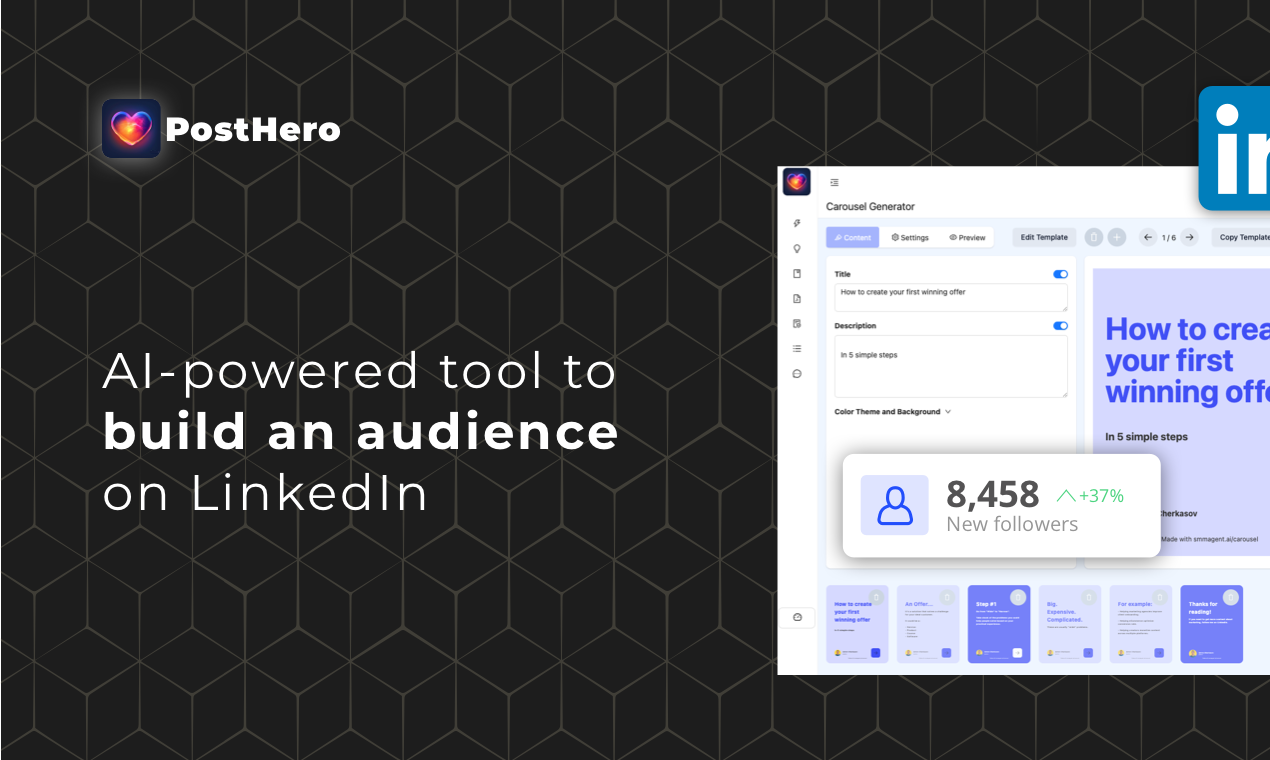
Create high-converting content that helps you grow on LinkedIn
Create a weekly content in 76 seconds
AI Voice assistant for creating content in seconds
The Content Autopsy: How to Analyze Why a Post Flopped (or Popped)
You post something. You check back a few hours later.
47 impressions. 2 likes. No comments.
“Huh. Guess that one didn’t work.”
And then you move on. Write the next post. Hope it does better.
Sound familiar?
Here’s the problem with that.
You just wasted the most valuable thing that post gave you: data.
Every post you publish is an experiment. It tells you something about your hook, your topic, your audience, your timing. But only if you actually look.
Most people don’t. They glance at a number, feel good or feel bad, and keep guessing.
That’s why they’re still guessing two years later.
Today I’m giving you a 10-minute post-mortem you can run on any post. Flop or hit. Both teach you something.
Let’s cut it open.
Why Most People Skip This
Two reasons.
Reason 1: It feels bad.
Looking closely at a post that flopped is uncomfortable. Easier to blame the algorithm and move on.
Reason 2: They don’t know what to look at.
They open analytics, see impressions, and have no idea what to do with that number.
Both are fixable.
The autopsy isn’t about judging yourself. It’s about finding one thing to fix next time.
One small fix per post, 3 posts a week, for a year. That’s 150 improvements.
That’s how people get good at this.
When to Run the Autopsy
Wait 24-48 hours after posting.
Not 2 hours. Early numbers lie. A slow start can turn into a strong post. A fast start can stall.
Give it a full cycle. Then look.
I do mine once a week. I open my last 3-4 posts and run through the same checklist for each.
10 minutes total. That’s it.
The 5-Step Autopsy
Here’s the checklist. Same questions every time.
Step 1: Check the impressions-to-engagement ratio
Don’t look at raw numbers. Look at the ratio.
A post with 3,000 impressions and 8 likes is a different problem than a post with 200 impressions and 15 likes.
High impressions, low engagement = LinkedIn showed it to people, but they didn’t care. Your topic or your body copy is the problem. The hook worked. The rest didn’t.
Low impressions, high engagement = the people who saw it loved it. LinkedIn just didn’t push it. Often a timing issue, or you didn’t engage after posting.
Low impressions, low engagement = the hook died. Nobody clicked “see more.” Start there.
This one check tells you where to look next.
Step 2: Reread your first three lines. Out loud.
Cover everything below line 3. Read only what shows before “see more.”
Now ask: would I click?
Be brutal here. This is where most posts die.
Common killers:
The hook is a setup, not a hook (”I want to share some thoughts on...”)
Line 2 kills the momentum from line 1
You explained instead of intrigued
It’s three lines of context before anything interesting happens
If your hook is weak, nothing else in the post matters. It was never read.
Step 3: Look at WHO engaged, not how many
This is the step nobody does. And it’s the most important one.
Click into the reactions. Scroll the names. Look at their headlines.
Are these your ideal clients? Or are they other creators, random connections, people from a completely different industry?
A post with 15 likes from your exact target audience is worth more than 200 likes from people who’ll never buy.
I’ve seen posts “flop” on paper that generated two client calls. And posts “pop” that generated nothing but ego.
Vanity metrics lie. Audience quality doesn’t.
Track this every time. Patterns show up fast.
Step 4: Check what you did in the first hour
Pull up the post. Look at the timestamps on the comments.
Did you reply quickly? Did you reply at all?
Did you leave a pinned comment?
Were you even online when it went live?
Posts don’t succeed on their own. The first 60 minutes shape the reach.
If you posted and vanished, that’s your answer. It’s not the content. It’s the follow-through.
Easiest fix on this whole list.
Step 5: Ask the honest question
Last one. And it’s the hardest.
“Was this actually good?”
Not “did I work hard on it.” Not “is the advice correct.”
Was it interesting? Was it specific? Was it something only I could have written?
Or was it another generic take that could have come from anyone?
Sometimes the post flopped because the post wasn’t good. That’s fine. That’s normal. But you have to be able to say it.
If you can’t tell, use this test: would you have stopped scrolling for this if someone else wrote it?
Don’t Skip the Winners
Everyone autopsies the flops. Almost nobody autopsies the hits.
Big mistake.
When a post pops, run the exact same 5 steps. You need to know WHY it worked so you can do it again.
Was it the hook format? The topic? The story? The timing? The fact that you replied to 40 comments in an hour?
If you don’t know why it worked, you can’t repeat it. You just got lucky and you’ll spend the next month trying to catch lightning again.
Write down the reason. Keep a running list.
Over time that list becomes your personal playbook. Not generic advice from the internet. What works for YOUR audience.
The One-Line Log
Here’s how to make this stick.
After each autopsy, write one line in a doc:
“Jul 14 — story hook, tactical topic — 2.1K impressions, 30 comments, mostly founders — worked because the first line was a specific number”
“Jul 16 — question hook, opinion topic — 400 impressions, 4 comments, mostly creators — hook was too vague, didn’t create tension”
That’s it. One line per post.
After 20 posts you’ll see it. The hook types that work. The topics that land. The days that hit.
You stop guessing. You start knowing.
Most people have published 200 posts and learned nothing from any of them, because they never wrote anything down.
The Trap to Avoid
One warning.
Don’t overcorrect after a single post.
One flop doesn’t mean the topic is dead. One hit doesn’t mean you found the formula.
LinkedIn is noisy. Individual posts are random. A great post can flop because you published during a holiday, or because someone big posted at the same time, or for no reason at all.
Look for patterns across 10+ posts. Not signals from one.
If three posts on the same topic all flopped, that’s a pattern. If one did, that’s noise.
Patience with the data. Same as patience with the growth.
Your Homework
This week, do this:
Open your last 3 posts. Run all 5 steps on each. Takes 10 minutes.
For each one, write down ONE thing you’d change.
Start your one-line log. Even a note on your phone works.
Include at least one post that did well. Figure out why.
Apply what you learned to your next post. Just one change. Not five.
Every post you’ve already published is sitting there with lessons in it.
Go read them.
That’s it for this week.
If you run an autopsy and find something surprising, reply and tell me what it was. I’d love to hear.
See you next time.
That’s a wrap for today.
See you next week! If you want more LinkedIn tips, be sure to follow me on LinkedIn (link).
If you love this episode and want to support us, spread the word about us by sharing The LinkedIn Secrets with colleagues. I really appreciate it!
Thank you for reading!
What’d you think of today’s edition?
Help me to understand what you think about this episode. Just reply with a number (1, 2, or 3) to this email.
1 - Damn good
2 - Meh, do better
3 - You didn’t cook it
Your compadre,
Anton “LinkedIn growth strategies” Cherkasov