

Hi there,
I research top LinkedIn posts and show you how to create content that lands.
What’s hot this week: OpenClaw is still trending. More and more people are posting tips and use cases for creating LinkedIn content with it.
OpenClaw is the most advanced AI assistant framework, and you can try it without code using this 1-click setup on ClawPlane.
In this issue, you’ll find:
The 3 high-performing LinkedIn posts this week
LinkedIn SEO: How to make your content rank in AI search
The 3 high-performing posts this week
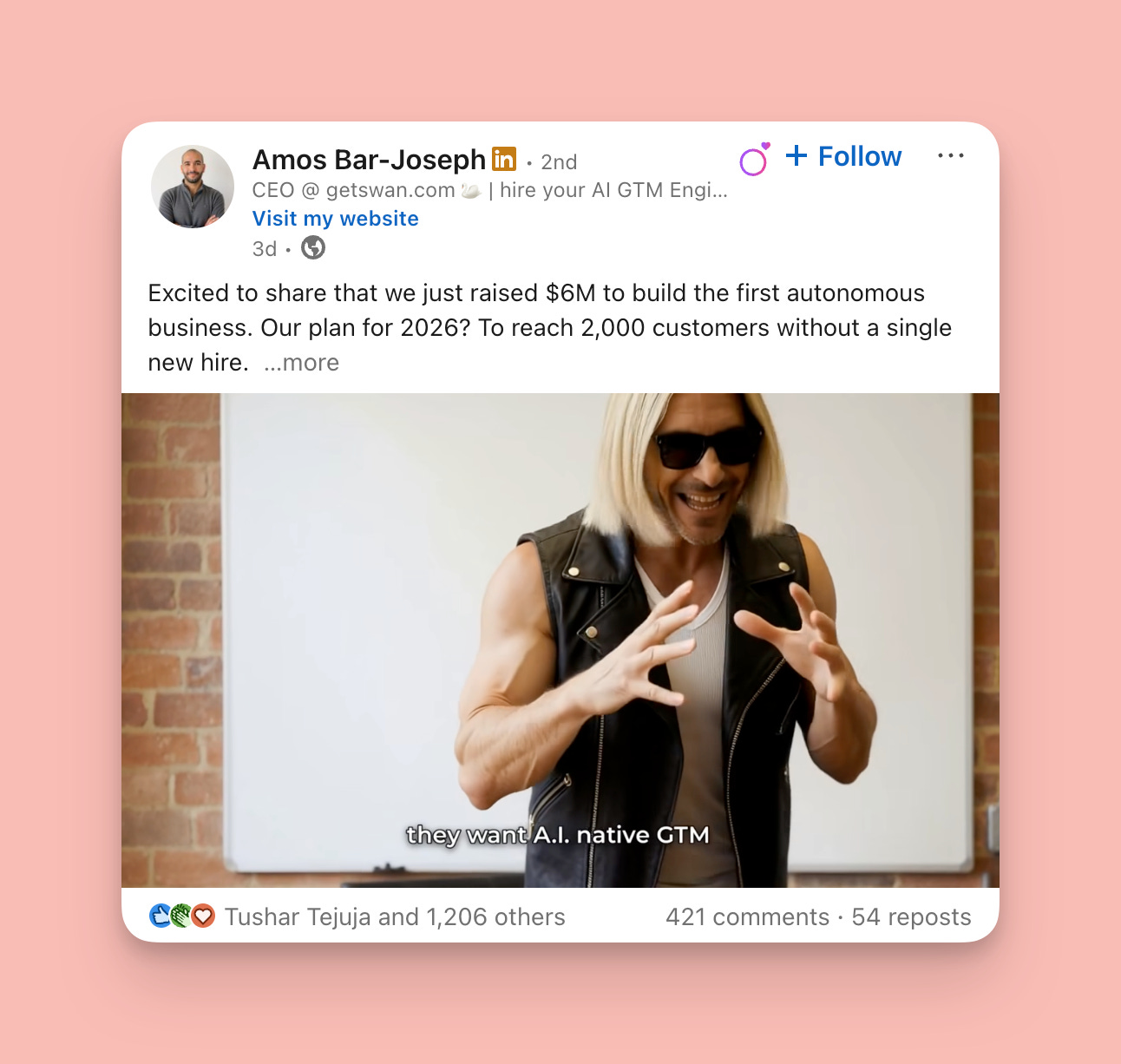
1. Excited to share that we just raised $6M to build the first autonomous business.
Why this post?
This post went viral, receiving 1,206 likes in 3 days. It received 5-17 times more reposts than other Amos’s posts this week.
WHY THIS POST WENT VIRAL
This post isn’t just a funding announcement - it’s a manifesto for a new way to build companies with memorable video.
BREAKDOWN
Funding hook with bold claim: “$6M to build the first autonomous business” - not just another raise, it’s a new category
Audacious goal: “2,000 customers without a single new hire“ - makes you stop and question if that’s even possible
Proof of concept with receipts: 0 to 200+ customers, 5 continents, $1.5M monthly pipeline, just 3 founders + AI agents, zero employees, zero SDRs, zero marketing budget - overwhelming evidence
Simple analogy: “Developers got Claude Code. Revenue teams got Swan.” - instantly explains the product
Tags believers: Names investors (Boaz Fachler, Zaki Djemal, etc.) who “were crazy enough to bet $6M on this thesis” - gives them credit while expanding reach
Scroll-stopping video: Guy in blonde wig and leather vest - bizarre, memorable, demands a click
TRY THIS
Frame your funding announcement as the start of a new category, not just growth capital
Set a goal that sounds almost impossible - it forces people to engage
Use an unexpected or absurd visual to break the pattern of boring LinkedIn content
TOGETHER WITH POSTHERO
Grow your audience faster on LinkedIn. With an AI-powered tool that helps you create content and grow on LinkedIn.
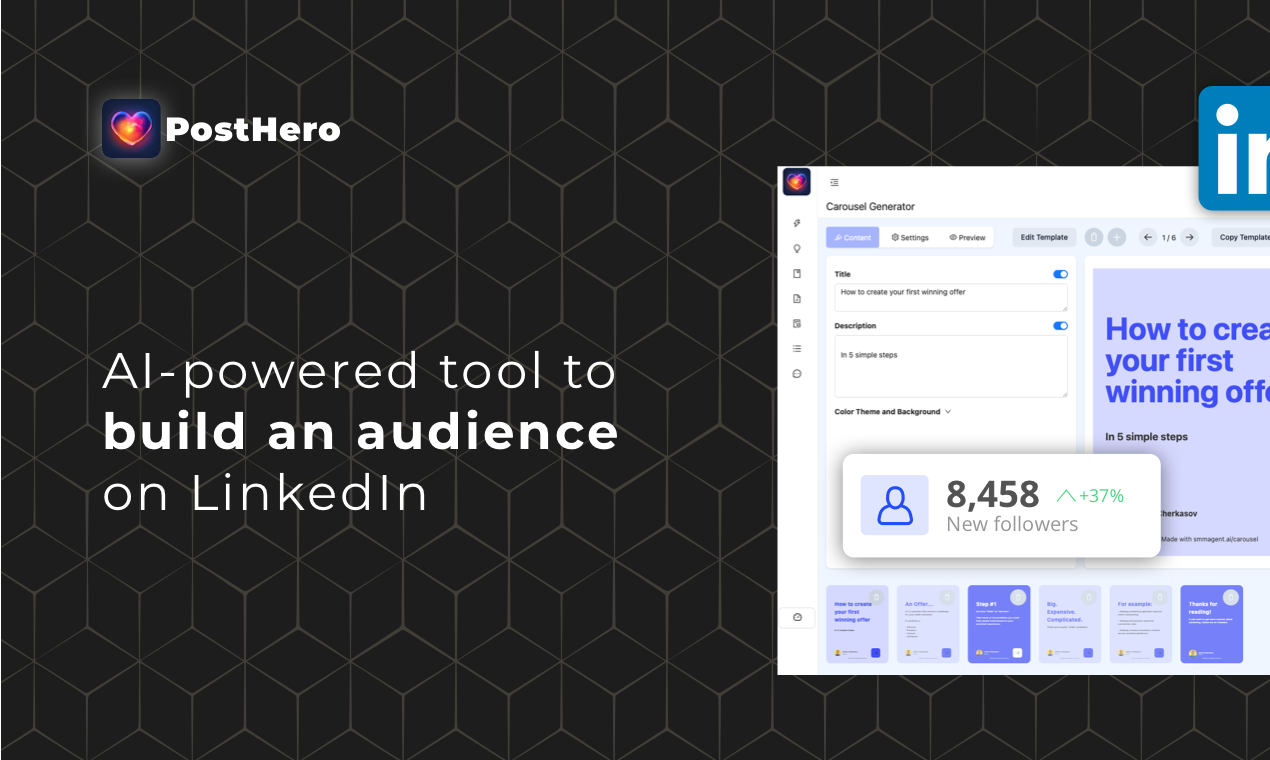
Create high-converting content that helps you grow on LinkedIn
Create a weekly content in 76 seconds
AI Voice assistant for creating content in seconds
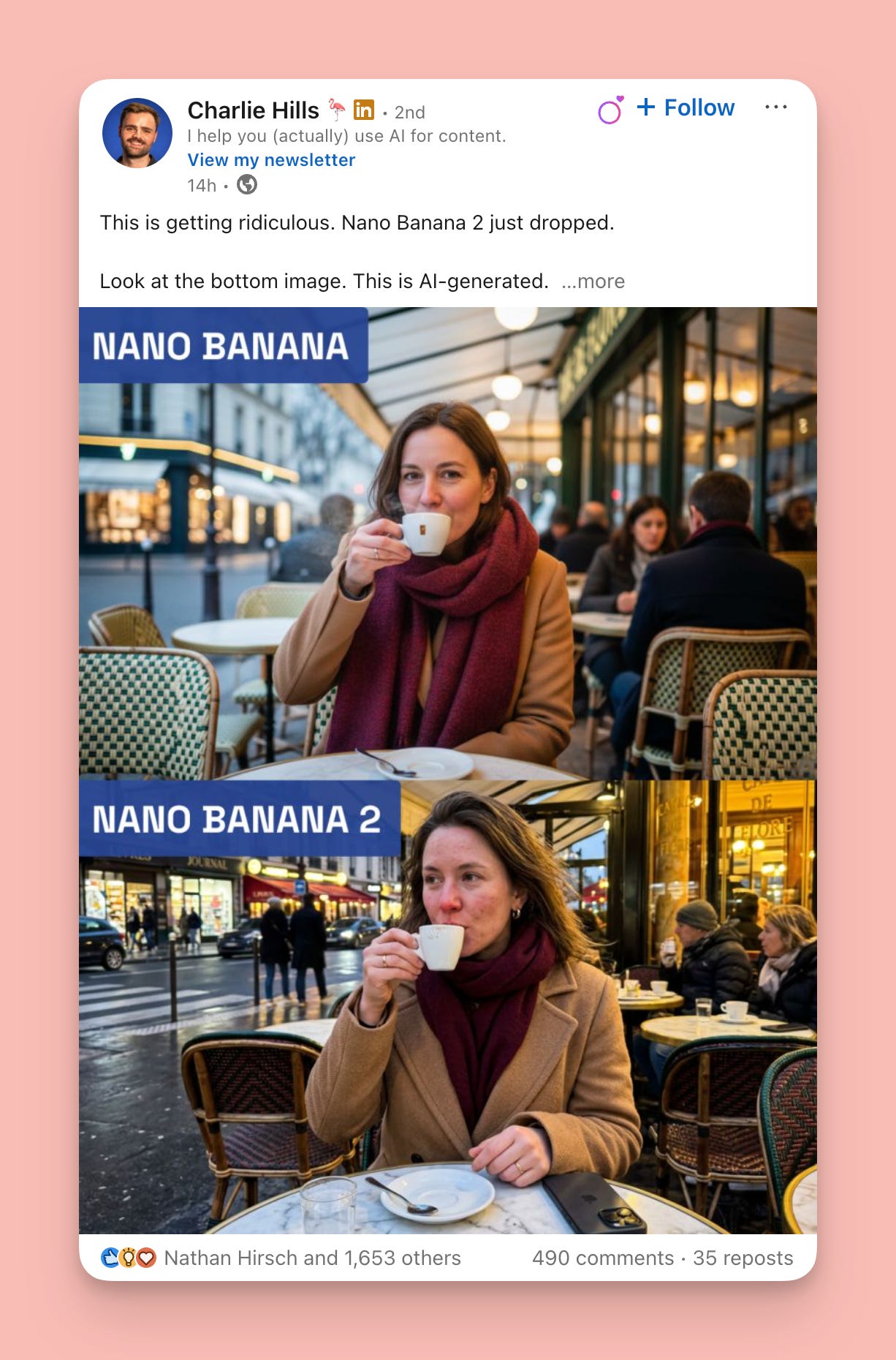
2. This is getting ridiculous. Nano Banana 2 just dropped.
Why this post?
Another post that went viral this week - it got almost 1.6k likes in just 14 hours and performed 2-11 times better than Charlie’s previous content.
WHY THIS POST WENT VIRAL
This post captures a “holy shit” moment in AI progress. The bottom image is so realistic it’s unsettling - visible pores, natural skin redness, condensation on the cup, accurate real-world location details.
BREAKDOWN:
Disbelief hook: “This is getting ridiculous” - emotional reaction that makes you want to see why
News peg: “Nano Banana 2 just dropped” - timely, first-mover content on a new release
Fair comparison: Same exact prompt on both models - makes the improvement undeniable
Insanely detailed prompt: Location, clothing, lighting, skin texture, camera type, film grain - shows what good prompting looks like
TRY THIS
Jump on new AI tool releases fast - being first matters for this type of content
Use comparison images to make progress undeniable - before/after or old/new
Share your exact prompt or method - transparency builds trust and adds value
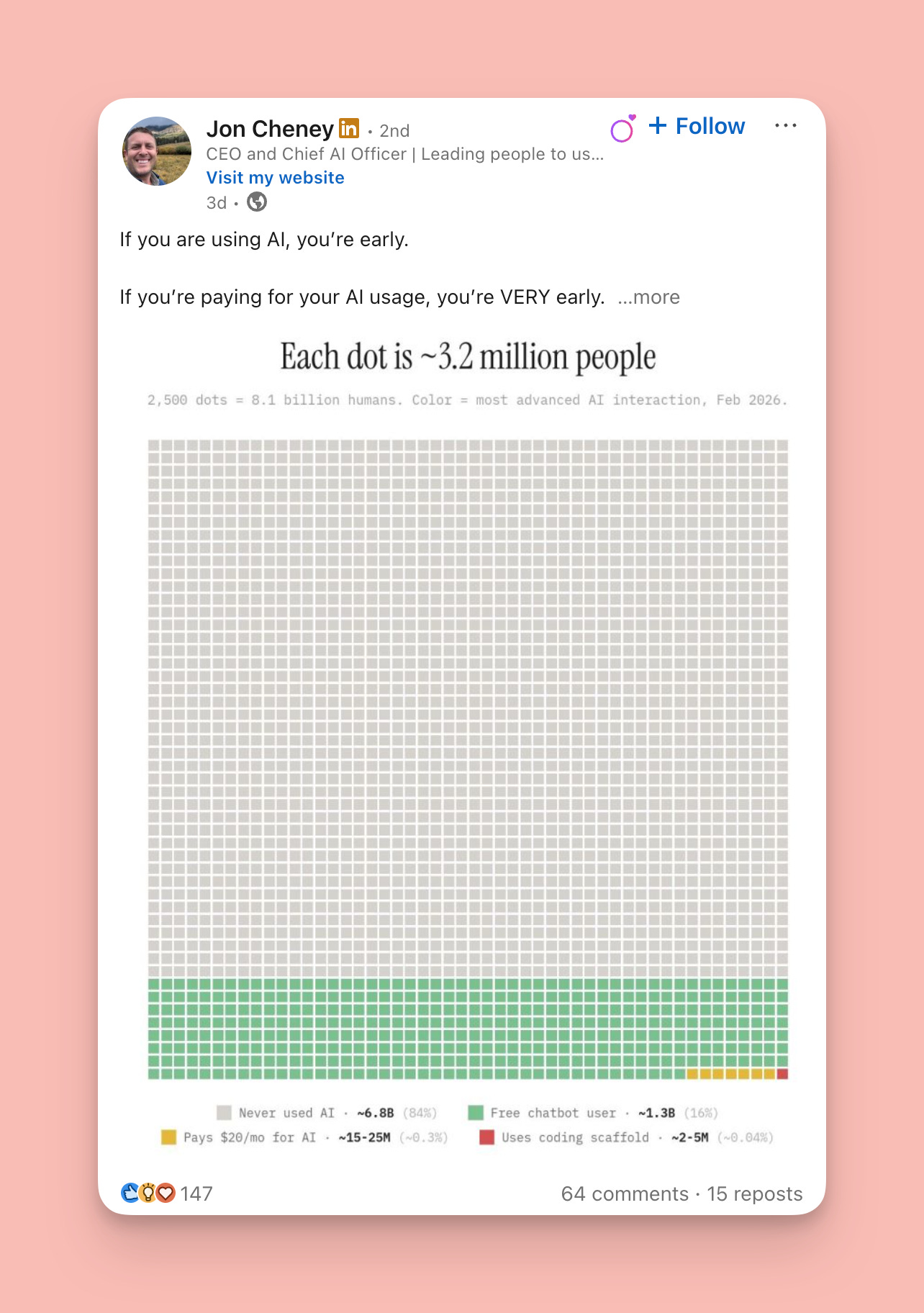
3. If you are using AI, you’re early.
Why this post?
This post got 2-20 times more comments than Jon’s other posts this week.
WHY THIS POST WENT VIRAL
This post makes every AI user feel like an early adopter - which is flattering and motivating.
BREAKDOWN:
Reassurance hook: “If you are using AI, you’re early” - immediately makes readers feel ahead of the curve
Perspective shift: “For billions of people, this hasn’t even started yet” - reframes the AI hype as still incredibly niche
Specific percentages: 84% never used AI, 16% free users, 0.3% paying, 0.04% coding with AI - makes the scale undeniable
Brilliant visualization: 2,500 dots representing 8.1 billion humans - instantly shows how small the “AI crowd” really is
TRY THIS
Use “you’re early” framing to make your audience feel ahead, not behind
Visualize scale in a way that makes abstract numbers feel real - dots representing millions hits harder than percentages alone
Challenge the assumption that “everyone is doing X” by showing the real numbers
LinkedIn Guide
LinkedIn SEO: How to make your content rank in AI search
Something big is happening.
And most LinkedIn creators are completely missing it.
AI search is taking over.
People aren’t just Googling anymore. They’re asking ChatGPT. They’re using Perplexity.
And here’s the thing: AI doesn’t read content the same way humans do.
If your content isn’t optimized for AI search, you’re becoming invisible.
Not today. Not tomorrow. But slowly, quietly, you’re disappearing from the results.
I’ve been paying attention to this shift for a while. LinkedIn just released their official guide on “How to optimize your content for AI search” (link).
This isn’t a theory anymore. It’s happening now.
Let me show you how to stay visible.
How AI “Reads” Your Content
AI doesn’t read like humans.
Humans skim. They look for bold text. They jump around. They get the vibe.
AI parses. It looks for structure. It looks for clear statements. It looks for specific, actionable information.
If your content is vague, fluffy, or poorly structured... AI skips it.
If your content is clear, specific, and well-organized... AI loves it.
That’s the difference between being cited and being ignored.
8 Rules for LinkedIn SEO in 2026
Here’s how to optimize your content so AI can find it, read it, and rank it.
Rule 1: Write Steps as Imperatives
This is a small change that makes a big difference.
Imperatives are commands. “Do this.” “Write that.” “Start here.”
Not “doing this” or “writing that” or “starting here.”
Active verbs. Direct instructions.
Bad: “Writing better hooks is important for engagement.”
Good: “Write better hooks to increase engagement.”
AI understands imperatives more clearly. They’re easier to parse, quote, and summarize.
Go through your content. Find the “-ing” verbs. Change them to commands.
Rule 2: Add ALT Descriptions to Your Images
Most people skip this completely.
When you upload an image to LinkedIn, you can add ALT text. It’s meant for accessibility. Screen readers use it to describe images to visually impaired users.
But here’s the thing: AI reads ALT text too.
If your image has no description, AI has no idea what it’s about. It can’t index it. It can’t reference it.
If your image has a clear, descriptive ALT text, AI can understand and cite it.
This takes 10 seconds per image. Start doing it.
Rule 3: Max 20 Words Per Sentence
Readability matters. For humans AND for AI.
Long, complex sentences confuse everyone. Short sentences are easier to parse.
The rule: no more than 20 words per sentence.
If a sentence is longer, break it up. Two short sentences beat one long one.
This also makes your content easier to quote. AI loves pulling clean, standalone statements.
Rule 4: Optimize Your Visual Structure
AI needs to understand the hierarchy of your content.
What’s the main point? What’s a subpoint? What’s an example?
If everything looks the same, AI gets confused.
How to fix this:
Use clear sections with headers (if writing articles or newsletters)
Use numbered lists for steps
Use bullet points for related items
Put the most important information first
Make your structure scannable
AI should know exactly what’s first, second, third.
Rule 5: One Topic Per Post
It’s essential for AI.
If your post covers 3 different topics, AI doesn’t know how to categorize it. It won’t rank for any of them.
If your post goes deep on one specific topic, AI can index it properly. It knows exactly what this content is about.
One post = one topic = one clear takeaway.
Save the other ideas for other posts.
Rule 6: Provide Actionable Steps
AI search is often looking for “how to” content.
“How do I write better LinkedIn posts?”
“How do I optimize my profile?”
“How do I get more engagement?”
If your content answers these questions with specific, actionable steps... you win.
Vague advice doesn’t rank. Specific actions do.
Bad: “You should focus on creating valuable content.”
Good: “Write one tactical post per week that solves a specific problem. Include 3-5 actionable steps. End with a question to drive comments.”
See the difference? One is fluff. One is useful.
Rule 7: Rename Carousels as “Article Titles”
Here’s a trick most people don’t know.
When you upload a carousel (PDF) to LinkedIn, you can rename it after uploading.
Don’t leave it as “Document.pdf” or whatever your file was called.
Rename it to a clear, descriptive title. Like an article headline.
“7 Steps to Write Better LinkedIn Hooks”
“The Complete Guide to LinkedIn Profile Optimization”
“How to Get More Engagement on Your Posts”
This helps LinkedIn (and AI) understand what your carousel is about.
Same goes for video posts. The first textual line of your video post acts as the “title.”
Make it clear and descriptive.
Rule 8: Format Long-Form Content Like a Blog
If you write LinkedIn articles or newsletters, treat them like blog posts.
That means:
Clear headline with your main keyword
Subheadings that break up sections
Short paragraphs (2-3 sentences max)
Bullet points for lists
Bold text for key points
A clear conclusion
This structure helps AI parse your content. It can pull specific sections. It can quote specific points.
Wall-of-text articles don’t rank. Well-structured articles do.
Bonus: Use the Post Itself as a Demonstration
Here’s a meta trick.
If you’re teaching something, demonstrate it in the same post.
Writing about hooks? Make your hook great.
Writing about structure? Make your structure perfect.
Writing about SEO? Optimize the post for SEO.
This does two things:
It proves you know what you’re talking about.
It makes the post itself more likely to rank.
Your content becomes both the lesson and the example.
Why This Matters Now
Some people think this is future stuff.
“AI search isn’t mainstream yet.”
“I’ll worry about it later.”
“My content is fine for now.”
That’s the wrong mindset.
The content you create today will be indexed for years. If it’s not optimized for AI, it won’t rank when AI search fully takes over.
And that takeover is happening faster than you think.
Start optimizing now. While your competitors are still sleeping on this.
Your Homework
This week, try this:
Go back to your last 5 posts. Check if your sentences are under 20 words. Fix the long ones.
Next time you post an image, add ALT text. Describe what’s in the image clearly.
Next time you post a carousel, rename it to a clear, descriptive title.
Write your next post with one topic only. Go deep. Add specific, actionable steps.
Structure everything clearly. First, second, third. Make it scannable.
Small changes. Big impact over time.
AI search is coming. Make sure your content is ready.
That’s it for this week.
If you start optimizing for AI search, reply and let me know. I’d love to hear what changes you make.
See you next time.
That’s a wrap for today.
See you next week! If you want more LinkedIn tips, be sure to follow me on LinkedIn (link).
If you love this episode and want to support us, spread the word about us by sharing The LinkedIn Secrets with colleagues. I really appreciate it!
Thank you for reading!
What’d you think of today’s edition?
Help me to understand what you think about this episode. Just reply with a number (1, 2, or 3) to this email.
1 - Damn good
2 - Meh, do better
3 - You didn’t cook it
Your compadre,
Anton “LinkedIn growth strategies” Cherkasov