

Hi there,
I break down top LinkedIn posts so you can craft content that resonates.
In this issue, you’ll find:
The 3 high-performing LinkedIn posts this week
The weekly content ritual: my 60-minute system for never missing a post
The 3 high-performing posts this week
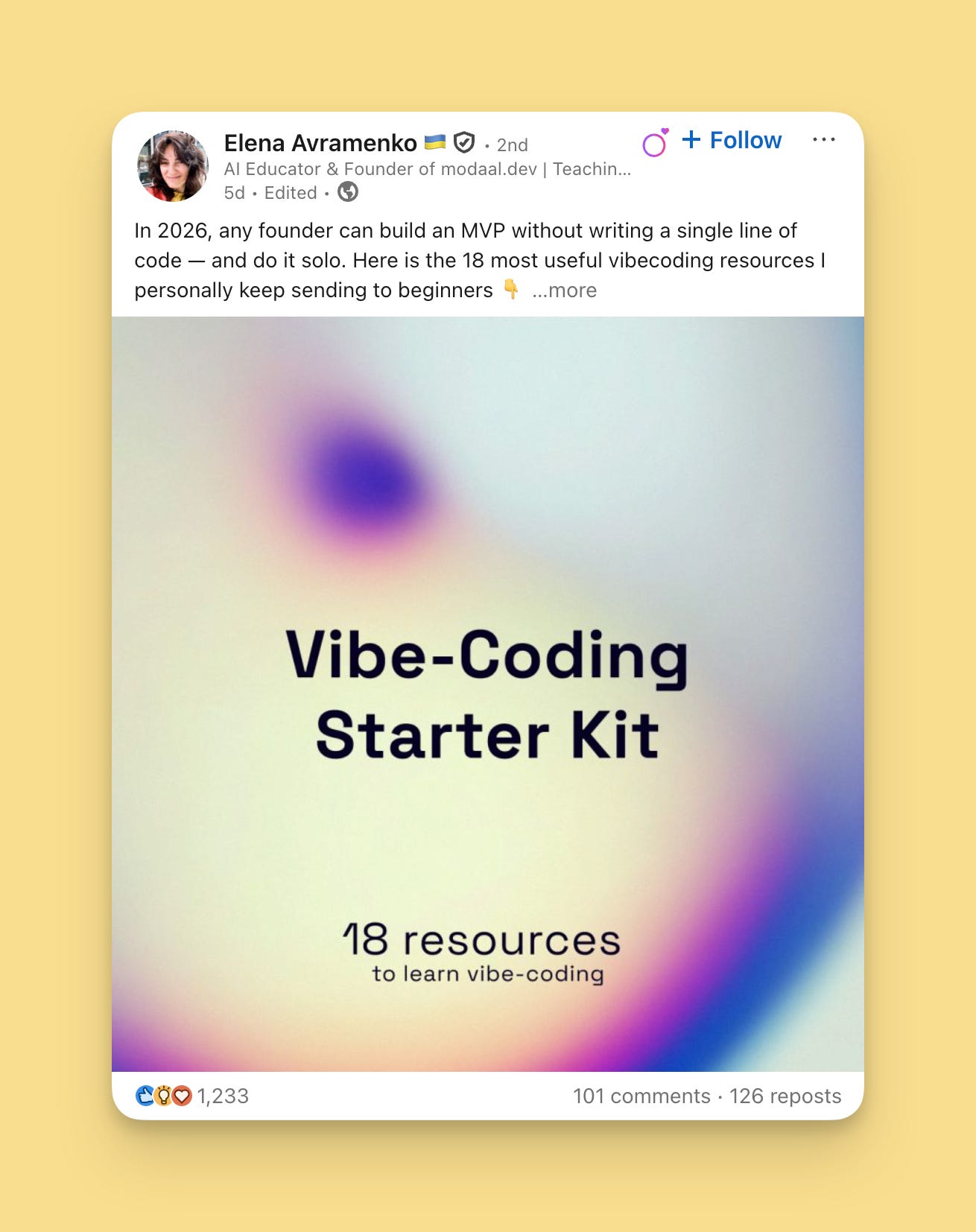
1. In 2026, any founder can build an MVP without writing a single line of code
Why this post?
This post went viral, receiving 1.2k likes in 5 days. It received 10-30 times more engagement and views than Elena’s posts this week.
WHY THIS POST WENT VIRAL
Vibe-coding is one of the hottest topics in tech right now, and most people don’t know where to start.
BREAKDOWN
Timely hook: “In 2026, any founder can build an MVP without writing a single line of code“ - taps into a hot trend
Personal curation angle: “Resources I personally keep sending to beginners“ - feels like insider knowledge, not a generic list
Clear learning framework: Breaks vibe-coding into steps - follow courses, steal prompt patterns, learn workflows, copy from demos
Organized categories: Groups 18 resources into 6 clear sections - courses, prompting playbooks, tool docs, agent workflows, planning helpers, demos
Concrete timeline: “In 2 weeks, you can have a working MVP. In 2 months, you can have your first paying users.” - makes the outcome feel real
TRY THIS
Curate resources around a trending topic before the market gets saturated with guides
Frame it as “what I personally use/send” - it adds trust and feels less like content marketing
Include direct links to everything - no friction, no gatekeeping
TOGETHER WITH POSTHERO
Grow your audience faster on LinkedIn. With an AI-powered tool that helps you create content and grow on LinkedIn.
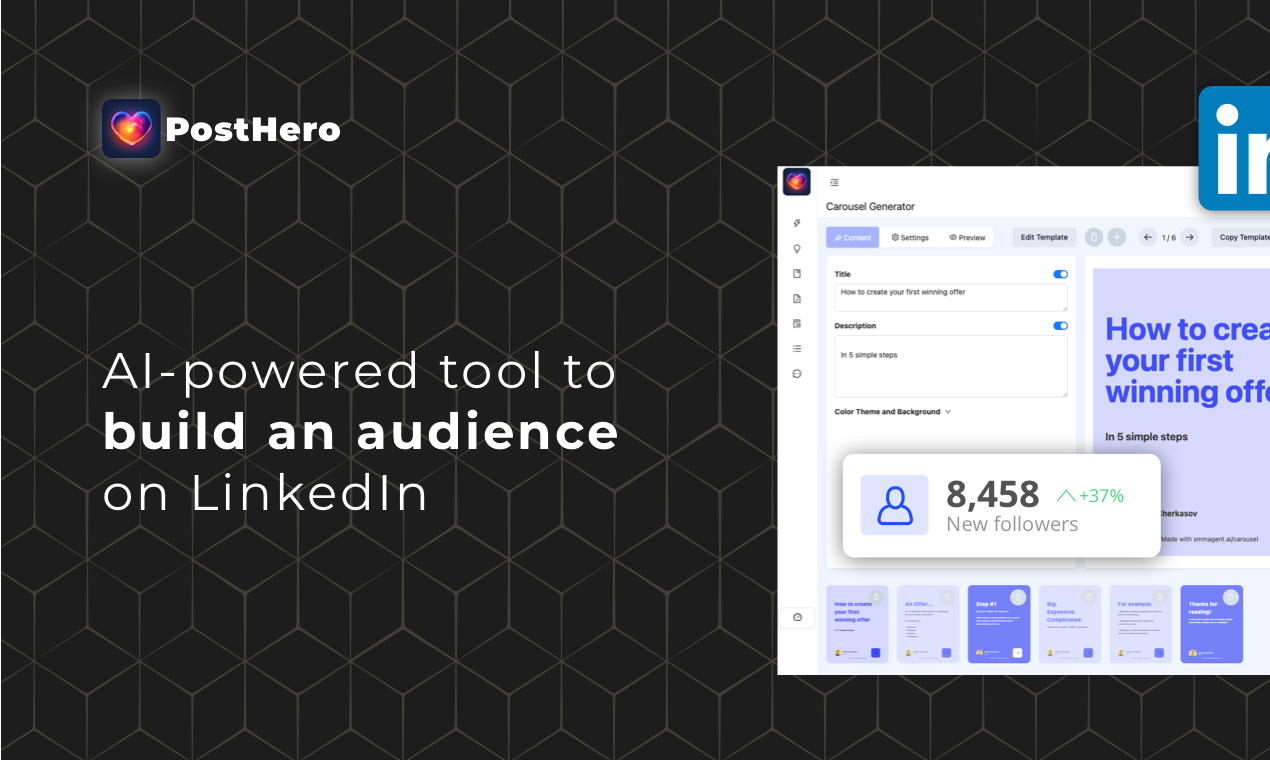
Create high-converting content that helps you grow on LinkedIn
Create a weekly content in 76 seconds
AI Voice assistant for creating content in seconds
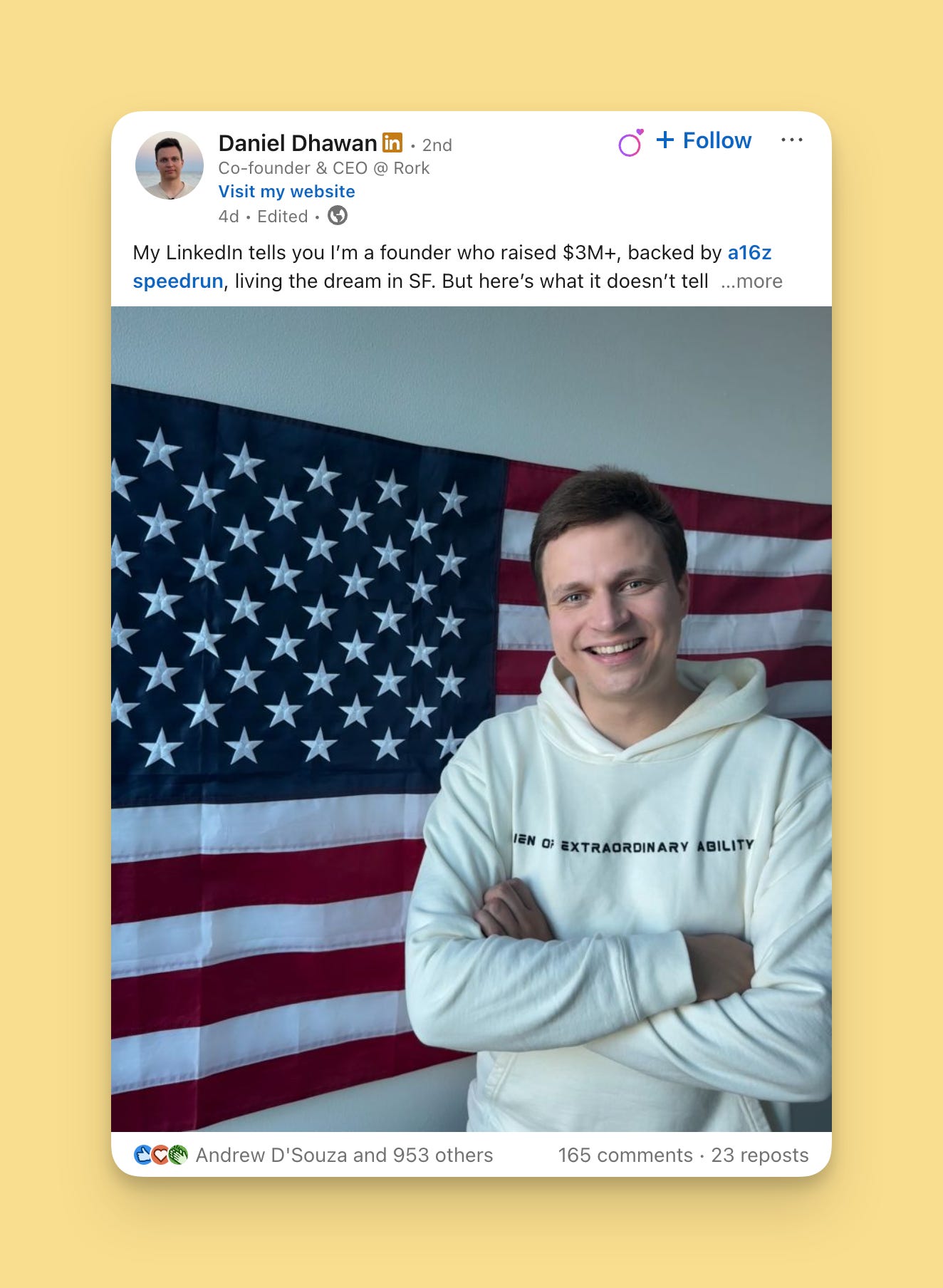
2. My LinkedIn tells you I’m a founder who raised $3M+, backed by a16z speedrun, living the dream in SF.
Why this post?
Another post that went viral this week - it got almost 1k likes in 4 days and performed 3-20 times better than Daniel’s previous content.
WHY THIS POST WENT VIRAL
Everyone sees founder success stories and assumes it was smooth. This post pulls back the curtain on what it actually takes.
BREAKDOWN:
Pattern interrupt hook: Opens with the polished LinkedIn version - $3M raised, a16z, SF - then flips it with “But here’s what it doesn’t tell you”
Raw struggle list: 8 YC rejections, 100+ VC nos, sleeping on a mattress, $15K in debt - stacks the pain fast
Admits mistakes: Almost killed the company, delayed launches, ignored users - shows he’s not just unlucky, he messed up too
Payoff moment: “Today, Rork has 1M+ users and multiple millions $ in ARR” - the contrast hits hard after all the struggle
Four clear lessons: Retention matters, talk to users, persistence beats talent, have a reason to keep going - actionable takeaways
Meta insight: “LinkedIn compresses years of struggle into a single outcome“ - names the thing everyone feels but doesn’t say
Encouraging close: “You might be just one iteration away from smth big” - leaves readers motivated
TRY THIS
Start with the “highlight reel” version of your story, then flip to reality - the contrast creates tension
Stack specific struggles fast - numbers hit harder than vague “it was hard”
Admit your own mistakes, not just external bad luck - it builds more trust
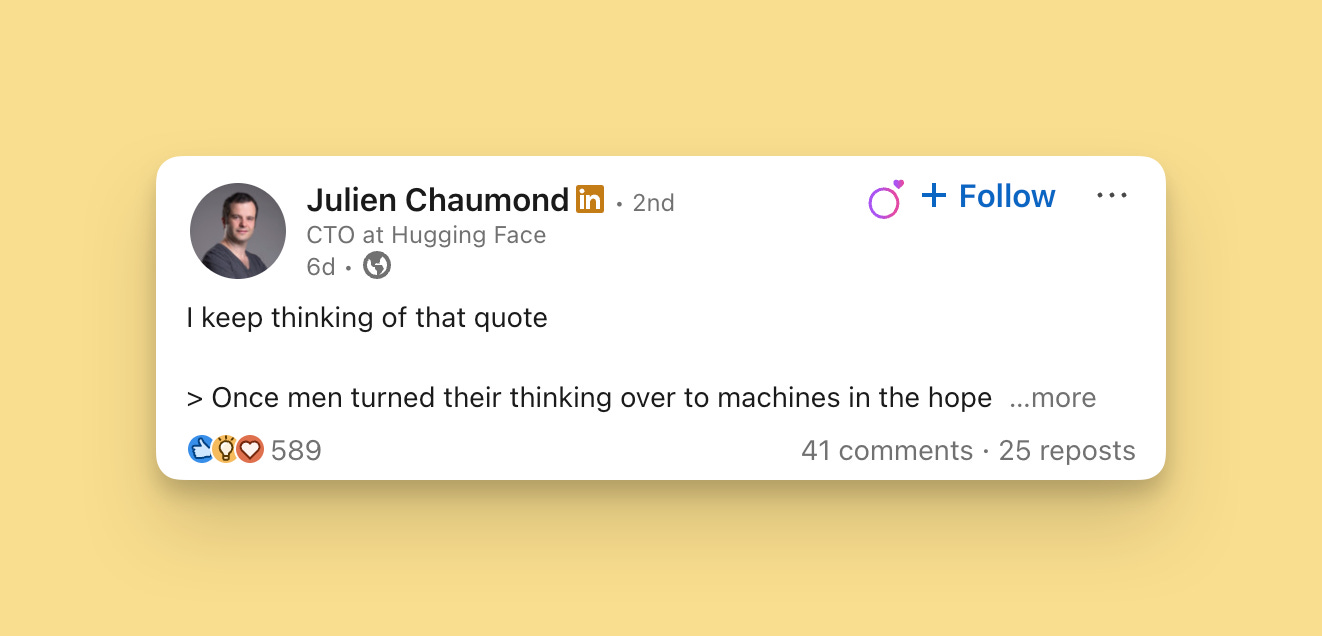
3. I keep thinking of that quote
Why this post?
This post got 2-17 times more comments than Julien’s other posts this week.
WHY THIS POST WENT VIRAL
This post works because of who’s saying it and when. The CTO of one of the biggest AI companies sharing a warning about machines and enslavement from a 1965 sci-fi novel feels loaded.
BREAKDOWN:
Minimal intro: “I keep thinking of that quote” - just 6 words, pure curiosity bait
Perfect quote selection: Dune on machines and freedom - written decades ago, hits different in 2026
Source credibility: CTO of Hugging Face posting about AI and power - the subtext writes itself
Simplicity as strategy: Entire post is 4 lines - stands out in a sea of long-form content
TRY THIS
Find a quote from literature, history, or philosophy that captures the current moment perfectly
Let your job title or position add meaning you don’t have to spell out
Sometimes the best commentary is no commentary - just the quote
Use fiction to talk about reality - it creates distance and feels less preachy
LinkedIn Guide
The Weekly Content Ritual: My 60-Minute System for Never Missing a Post
“I just don’t have time to post.”
I hear this every week.
Founders. Freelancers. Busy professionals. Everyone says the same thing.
But here’s what I’ve learned:
The people who post consistently aren’t less busy than you. They just have a system.
Consistency isn’t about willpower. It’s about ritual.
Today I’m sharing my exact weekly process. 60 minutes. One block. Content done for the week.
No more scrambling. No more guilt. No more “I’ll post tomorrow.”
Let’s break it down.
Why Willpower Doesn’t Work
Most people try to create content “when they have time.”
Spoiler: You never have time.
Monday you’re busy with client work. Tuesday you have meetings. Wednesday you’re tired. Thursday you finally sit down to write... and your brain is empty.
So you skip it. Again.
Then you see other people posting daily and think: “How do they do it? They must have more time than me.”
They don’t.
They just don’t rely on motivation. They rely on a system.
A repeatable ritual that happens the same time, same way, every single week.
That’s the secret.
The 60-Minute Weekly Content Ritual
Here’s my exact process.
I block 60 minutes once a week. Same day. Same time. Non-negotiable.
During that hour, I do 5 things:
Review (5 minutes)
Ideate (10 minutes)
Write (30 minutes)
Edit (10 minutes)
Schedule (5 minutes)
That’s it. One hour. Content done.
Let me walk you through each step.
Step 1: Review (5 minutes)
Before I create anything new, I look at what worked.
I check my posts from last week:
Which post got the most engagement?
Which one got the most comments?
Which one felt flat?
I’m not looking for deep analytics. Just patterns.
Did a personal story perform better than a tactical tip? Did a question at the end spark more comments?
This takes 5 minutes max. But it keeps me from repeating mistakes and helps me double down on what works.
Step 2: Ideate (10 minutes)
Now I brainstorm ideas for this week.
I don’t start from zero. I use my 4 content pillars:
Tactical (tips, how-tos, frameworks)
Transformation (results, wins, success stories)
Insightful (opinions, trends, hot takes)
Personal (stories, lessons, behind the scenes)
I pick which pillars I want to hit this week. Then I write down 3-5 rough ideas.
They don’t need to be perfect. Just a sentence or two.
Examples:
“Post about the client who ghosted me and what I learned”
“Share my process for writing hooks”
“Hot take: engagement pods are dead”
10 minutes. Ideas captured. Move on.
Step 3: Write (30 minutes)
This is the main block.
I pick 2-3 ideas from my list and turn them into drafts.
Here’s my shortcut: I use Posthero. Full disclosure: I built this tool because I was tired of staring at blank pages myself.
I dump my raw thoughts into the tool. Messy bullet points. Half-finished ideas. Voice notes. Whatever I have.
Posthero gives me an initial draft based on my inputs. It’s not perfect, but it gets me 80% there.
Then I take that draft and make it mine. My stories. My examples.
This saves me so much time. Instead of staring at a blank page, I’m editing and improving.
A few rules I follow:
One idea per post. No cramming.
Short sentences. Short paragraphs.
Write like I’m talking to one person.
30 minutes. 4-5 rough drafts done.
Step 4: Edit (10 minutes)
Now I clean things up.
I read each draft out loud. If it sounds weird, I rewrite it.
I check for:
Is the hook strong? Does line 2 keep you reading?
Is there one clear point?
Is it too long? (If it doesn’t fit on a phone screen, it’s too long.)
Does the ending invite a response?
I cut anything that doesn’t need to be there. Shorter is almost always better.
10 minutes. 5 posts polished.
Step 5: Schedule (5 minutes)
Last step. I schedule everything.
I use Posthero for this too. I can convert my LinkedIn posts into Twitter and Threads posts with one click. Then schedule all of them in one place.
I post Monday to Friday, afternoon Bali time. That hits morning in Europe and early morning in the US. Peak scrolling hours.
I load the posts. Set the times. Done.
5 minutes. Week sorted.
Now I don’t think about the content until next week’s ritual.
When to Do Your Ritual
Pick a time that works for you and protect it.
Some options:
Sunday noon (prep for the week ahead)
Monday morning (start the week with content done)
Friday afternoon (end the week strong)
Doesn’t matter which day. What matters is that you do it at the same time every week.
Put it in your calendar. Treat it like a client meeting. Don’t cancel on yourself.
What If You Miss a Week?
It happens.
Life gets crazy. You skip your ritual. You miss a few posts.
Don’t spiral. Don’t feel guilty. Just get back to the ritual next week.
One missed week doesn’t ruin your momentum. Quitting does.
The goal isn’t perfection. The goal is a system you can return to.
Why This Works
Three reasons:
You remove daily decisions.
You’re not waking up every day wondering “should I post today?” The decision is already made. You just follow the ritual.
You batch your creative energy.
Writing 3 posts in one focused hour is easier than writing 1 post on 3 different days. Your brain stays in content mode.
You build a habit that compounds.
The more you do your ritual, the easier it gets. After a few months, 60 minutes feels like nothing. And you’ll have months of consistent content behind you.
Your Homework
This week, try this:
Pick a day and time for your weekly ritual. Put it in your calendar.
Block 60 minutes. No distractions.
Follow the 5 steps: Review, Ideate, Write, Edit, Schedule.
Post your content and see how it feels.
One hour a week.
That’s all it takes to be more consistent than 90% of people on LinkedIn.
Stop waiting for motivation. Build a ritual instead.
That’s it for this week.
If you try the 60-minute ritual, reply and tell me how it went. I’d love to hear if it helped.
See you next time.
That’s a wrap for today.
See you next week! If you want more LinkedIn tips, be sure to follow me on LinkedIn (link).
If you love this episode and want to support us, spread the word about us by sharing The LinkedIn Secrets with colleagues. I really appreciate it!
Thank you for reading!
What’d you think of today’s edition?
Help me to understand what you think about this episode. Just reply with a number (1, 2, or 3) to this email.
1 - Damn good
2 - Meh, do better
3 - You didn’t cook it
Your compadre,
Anton “LinkedIn growth strategies” Cherkasov