

Hi there,
I study top LinkedIn posts to help you create content that really connects.
In this issue, you’ll find:
The 3 high-performing LinkedIn posts this week
Why your “helpful” content is actually forgettable
The 3 high-performing posts this week
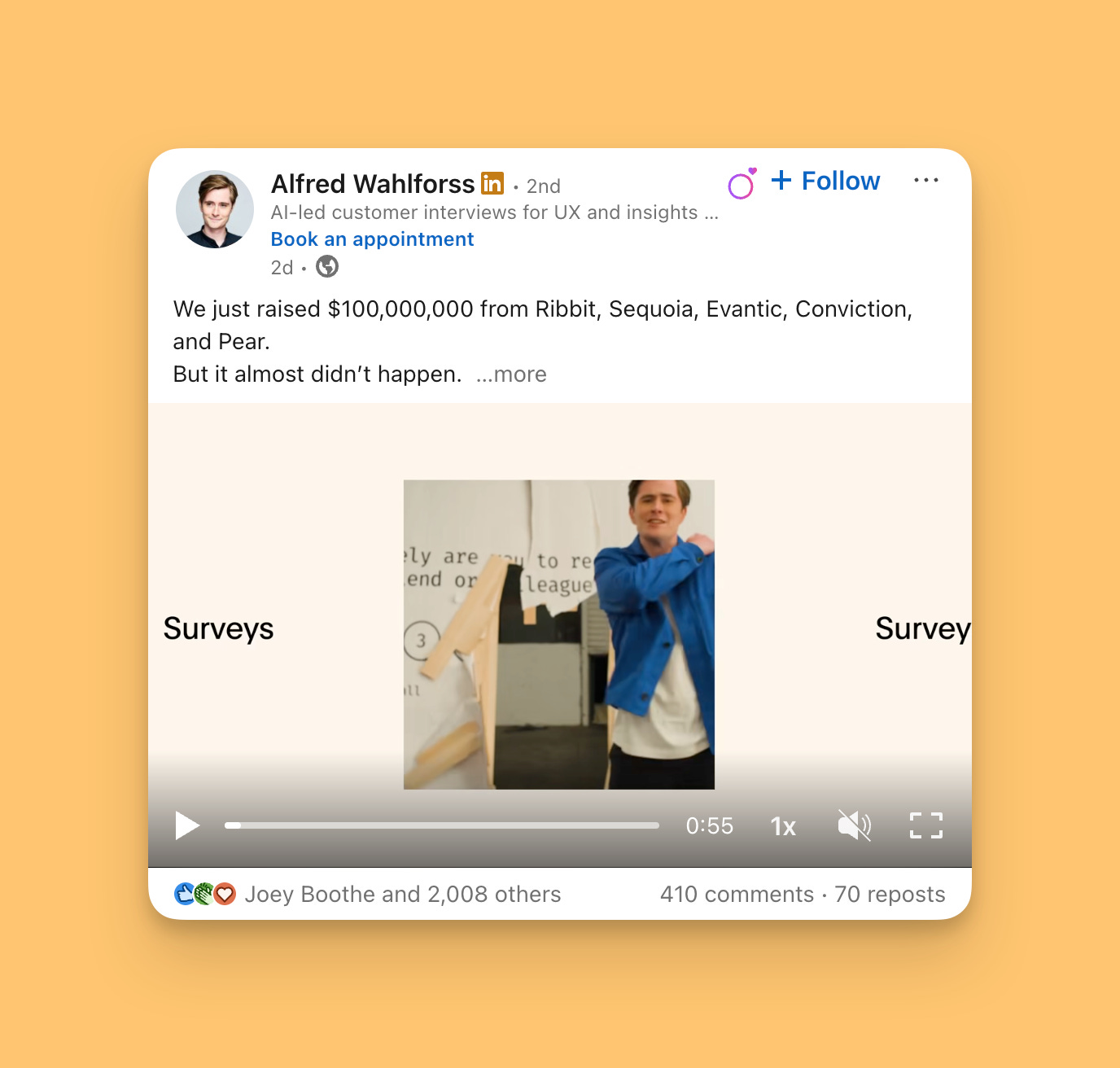
1. We just raised $100,000,000 from Ribbit, Sequoia, Evantic, Conviction, and Pear.
Why this post?
This post went viral, receiving 2k likes in 2 days. It received 6-25 times more engagement and views than Alfred’s posts this week.
WHY THIS POST WENT VIRAL
Fundraising announcements usually feel like bragging. This one works because it leads with struggle, not success.
BREAKDOWN
Massive hook: “$100,000,000” with big-name VCs (Sequoia, Ribbit) - stops the scroll instantly
Tension builder: “But it almost didn’t happen” - makes you want to know the story behind the number
Vulnerable backstory: 18 months in limbo, unreliable models, customers unsure, hiring struggles - shows the messy middle
Turning point: “About 9 months ago, it finally clicked” - satisfying narrative shift
Proof stack: 15x revenue, 8 figures, 1M+ interviews, Microsoft/Sweetgreen/Perplexity as customers - overwhelming evidence
Explains the problem: Traditional research costs $50-100k and takes months, so teams skip it and guess wrong - makes the product make sense
TRY THIS
Lead with the big number, then immediately add tension - “but it almost didn’t happen”
Share the unglamorous middle - limbo, doubt, struggles - before the win
Stack proof points fast - revenue, customers, scale - don’t make people guess if it’s real
TOGETHER WITH POSTHERO
Grow your audience faster on LinkedIn. With an AI-powered tool that helps you create content and grow on LinkedIn.
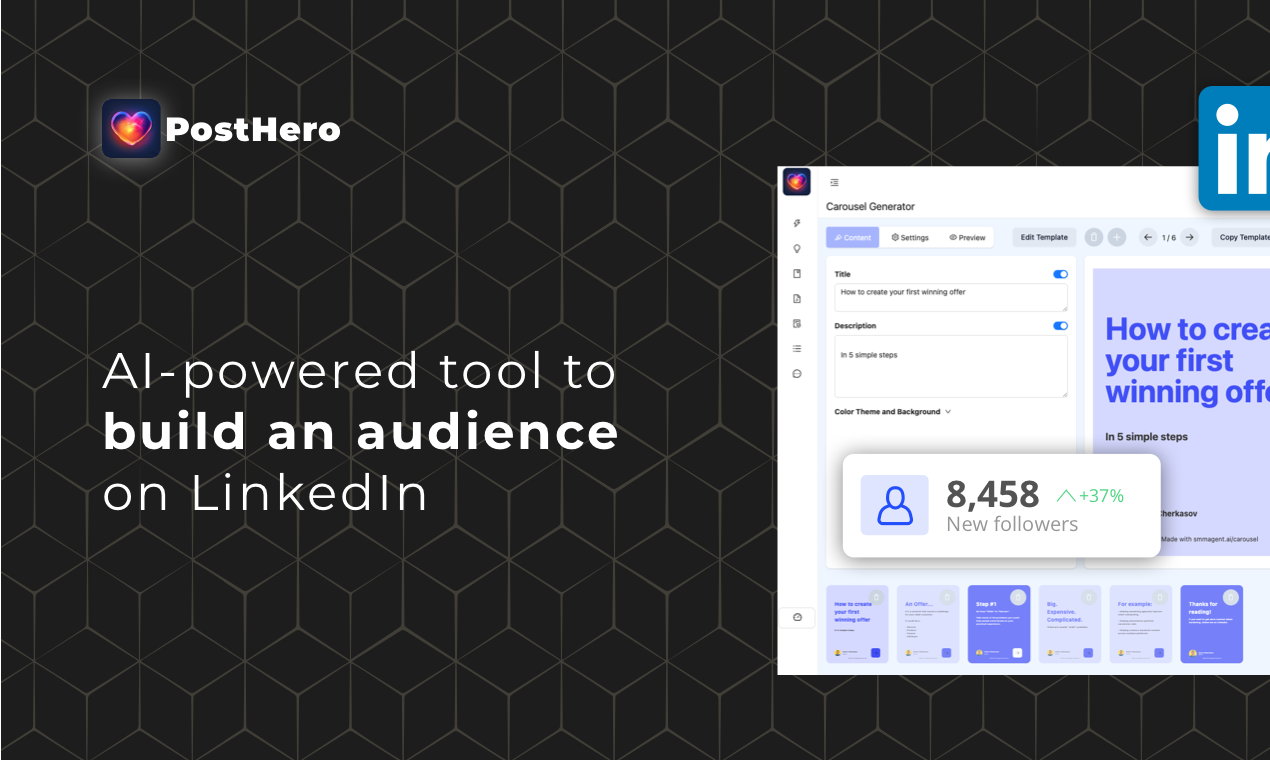
Create high-converting content that helps you grow on LinkedIn
Create a weekly content in 76 seconds
AI Voice assistant for creating content in seconds
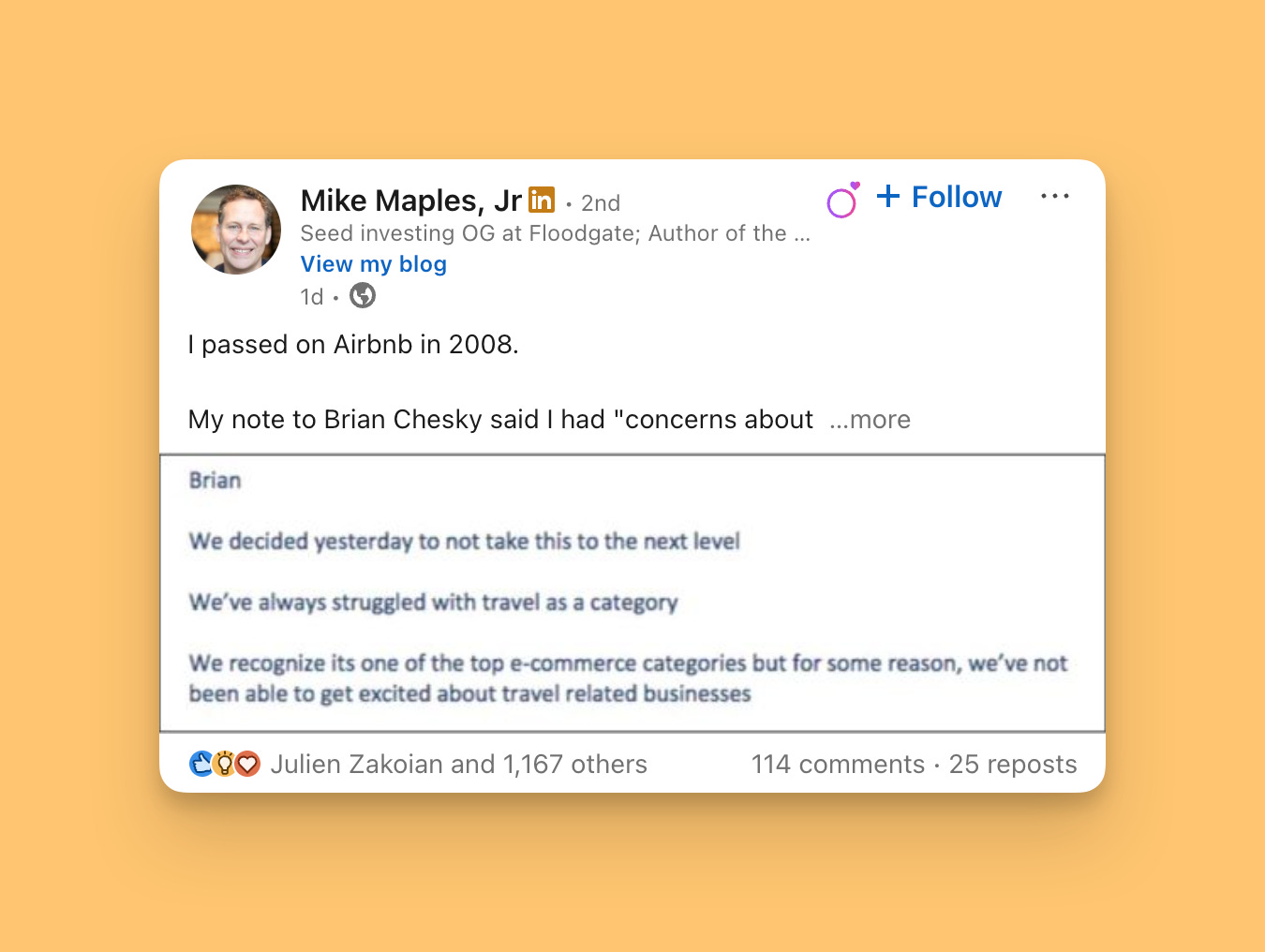
2. I passed on Airbnb in 2008.
Why this post?
Another post that went viral this week - it got 1.1k likes in a day and performed 10times better than Mike’s previous content.
WHY THIS POST WENT VIRAL
Everyone loves a “the one that got away” story - especially when it’s a legendary VC admitting he passed on a $100B+ company.
BREAKDOWN:
Confession hook: “I passed on Airbnb in 2008“ - famous VC admitting a massive miss is irresistible
Shows the receipts: Includes the actual rejection note to Brian Chesky - proves it’s real, not just a story
Self-deprecating honesty: “A masterpiece of missing the point“ - owns the mistake completely
Time creates credibility: “I’ve thought about that mistake for 16 years“ - this isn’t a hot take, it’s hard-won wisdom
Reframes common advice: “Most founders are told to find painful problems“ - sets up the contrarian insight
Key distinction: Pain invites you to improve the current game. Contradictions invite you to change which game gets played. - this is the gold
Concrete example: “Nobody said ‘I wish I could sleep in a stranger’s apartment‘” - makes the abstract idea click
Explains why he missed it: His identity was tied to old beliefs about marketplaces - goes deeper than surface analysis
TRY THIS
Share your biggest miss or mistake - but only if you can extract a real lesson from it
Turn a personal failure into a framework others can use
Explain WHY you made the mistake, not just THAT you made it - self-awareness builds trust
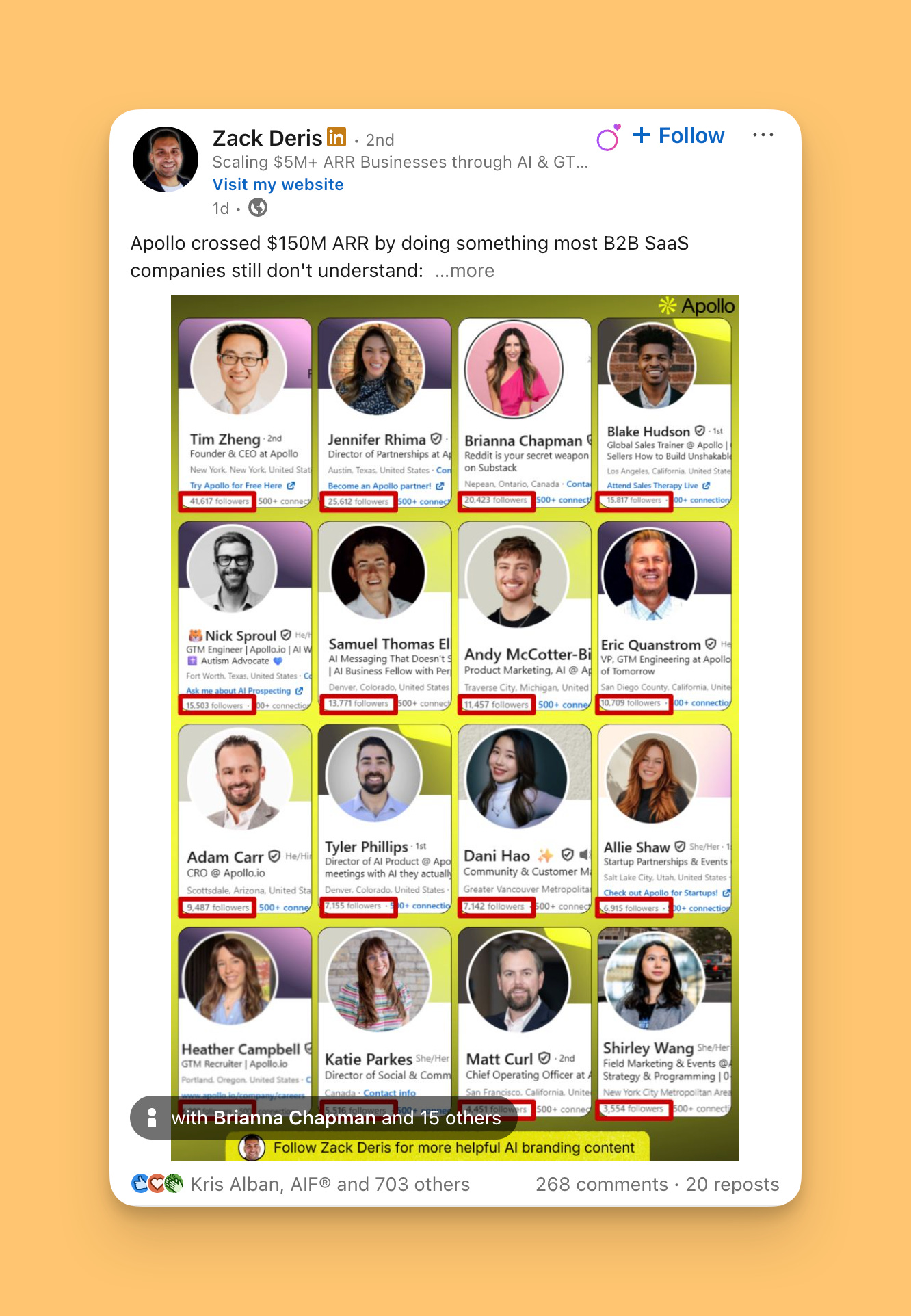
3. Apollo crossed $150M ARR by doing something most B2B SaaS companies still don’t understand
Why this post?
This post got 1.6-4 times more comments than Zack’s other posts this week.
WHY THIS POST WENT VIRAL
This post reverse-engineers a successful company’s growth playbook in a way that’s both educational and actionable.
BREAKDOWN:
Big number hook: “$150M ARR” - specific, impressive, gets attention
Contrarian setup: “By doing something most B2B SaaS companies still don’t understand” - creates curiosity gap
Origin context: Started in 2016 in a crowded market, now powering millions of GTM professionals - shows the journey
Names the strategy: “People-led distribution engine“ - gives the approach a memorable label
Four-part framework: Breaks down exactly how Apollo did it - structured and easy to follow
Names real people: Tim Zheng, Jennifer Rhima, Brianna Chapman, Katie Parkes - makes it tangible and tags them for reach
Specific proof points: 50K+ weekly AI users, 500% YoY AI growth, 47M prospecting actions - overwhelming evidence
TRY THIS
Reverse-engineer a company’s success into a clear framework others can learn from
Give your strategy a name - “people-led distribution engine” is memorable and shareable
Stack specific numbers to prove your points - vague claims don’t stick
LinkedIn Guide
Why Your “Helpful” Content Is Actually Forgettable
I had coffee with a founder friend last month.
Smart guy. Successful business. Knows his stuff.
But his LinkedIn content? Completely forgettable.
I asked him why he never talks about himself in his posts.
He said: “I don’t want to come off as arrogant.”
So instead, he posts generic advice. Leadership tips. Business wisdom. Stuff that sounds nice but could’ve been written by anyone.
I opened his profile later. Post after post of the same thing.
“A good leader needs to be empathetic.”
“Communication is key to success.”
“Always put your team first.”
Cool. But who are you? Why should I listen to you? What have you actually been through?
No answers.
Just advice floating in the air with no story attached.
The Irony of Playing It Safe
Here’s what’s funny.
My friend avoids personal stories because he thinks it’ll make him look arrogant.
But the opposite is true.
Generic advice without context actually makes you sound MORE arrogant. Not less.
Why?
Because you’re telling people what to do without showing how you earned the right to say it.
It’s like a fitness coach who never shows their own transformation. Or a business mentor who never talks about their failures.
You’re asking people to trust you. But you’re not giving them a reason to.
Why Your Story Matters
Let me be blunt.
Advice is everywhere.
Open LinkedIn right now. You’ll find 10,000 posts telling you to “be consistent” and “add value” and “build relationships.”
None of it is wrong. But none of it stands out either.
You know what’s rare?
Your story.
Only you got fired from that job. Only you failed that launch. Only you had that conversation with your dad that changed everything. Only you built your business while going through a divorce.
That’s the stuff people can’t copy.
That’s the stuff that makes them think: “I need to follow this person.”
Story + Advice = Magic
I’m not saying stop giving advice.
Advice is valuable. People need frameworks and tips and how-tos.
But advice alone is forgettable.
Advice connected to your story? That’s magic.
Look at the difference:
Without story: “Consistency is the key to growing on LinkedIn.”
With story: “I posted for 6 months with zero results. I almost quit. Then on month 7, everything changed. Here’s what I learned about consistency.”
Same advice. Completely different impact.
The second one makes you lean in. You want to know what happened. You trust the person because they’ve been through it.
What Happens When You Share Your Story
Three things:
People remember you.
Facts fade. Stories stick. When you attach your advice to a real experience, it becomes memorable.
You attract the right audience.
Your story acts as a filter. People who resonate with your journey will follow you. People who don’t will move on. Both are good outcomes.
You become impossible to copy.
Anyone can steal your tips. No one can steal your story. It’s your unfair advantage.
“But It Feels Weird Talking About Myself”
I hear this a lot.
My founder friend said the same thing. “It doesn’t feel natural.”
Here’s what I told him:
You’re not bragging. You’re explaining.
There’s a difference between:
“Look how successful I am.” (bragging)
and
“Here’s what I went through and what I learned.” (sharing)
One is about ego. The other is about helping people.
When you share your story, you’re giving context. You’re showing people why your advice matters. You’re letting them see the human behind the content.
That’s not arrogant. That’s generous.
How to Add Story to Your Content
You don’t need to write a memoir.
Just add small story moments to your posts.
Here’s a simple formula:
Start with a moment.
“Last year, I lost my biggest client.”
“I used to think hustle culture was the answer.”
“My first business failed in 6 months.”
Share what happened.
Give a few details. Make it real. Let people see the situation.
Connect it to the lesson.
What did you learn? What changed? What do you do differently now?
That’s it.
You’re not writing a novel. You’re just giving your advice some roots.
The Question to Ask Yourself
Before you hit publish on your next post, ask this:
“Could anyone have written this? Or does it sound like me?”
If a stranger could post the same thing with their name on it... you’re missing your story.
Add it.
Your experience is the thing that makes your content yours.
Your Homework
This week, try this:
Pick one piece of advice you always give.
Think about how you learned it. What happened? What did you go through?
Write a post that starts with that story, then leads to the advice.
Watch how differently people engage with it.
Advice is abundant.
Your story is scarce.
Start using it.
That’s it for this week.
If you try adding more story to your content, reply and let me know how it goes. I’d love to hear what you come up with.
See you next time.
That’s a wrap for today.
See you next week! If you want more LinkedIn tips, be sure to follow me on LinkedIn (link).
If you love this episode and want to support us, spread the word about us by sharing The LinkedIn Secrets with colleagues. I really appreciate it!
Thank you for reading!
What’d you think of today’s edition?
Help me to understand what you think about this episode. Just reply with a number (1, 2, or 3) to this email.
1 - Damn good
2 - Meh, do better
3 - You didn’t cook it
Your compadre,
Anton “LinkedIn growth strategies” Cherkasov