

Hi there,
I research top LinkedIn posts and show you how to create content that lands.
In this issue, you’ll find:
The 3 high-performing LinkedIn posts this week
The Re-Hook Method: why your second line matters more than your first
The 3 high-performing posts this week
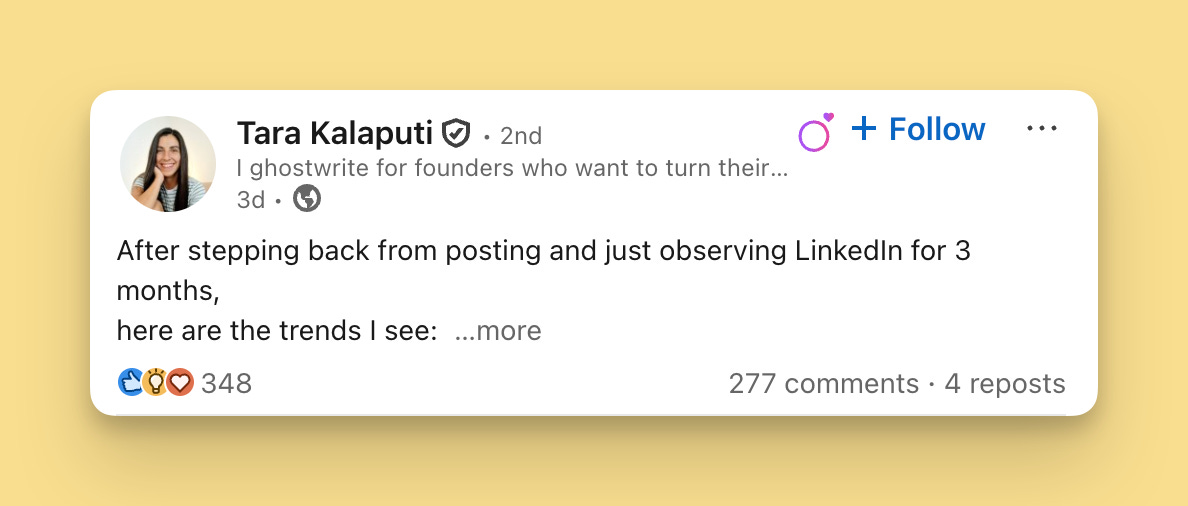
1. After stepping back from posting and just observing LinkedIn for 3 months…
Why this post?
This post went viral, receiving 348 likes in 3 days. It received 18-58 times more engagement and views than Tara’s posts this week.
WHY THIS POST WENT VIRAL
This post works because everyone on LinkedIn has opinions about what’s working on LinkedIn.
BREAKDOWN
Observer hook: “Stepping back for 3 months and just observing” - positions her as a researcher, not just another poster
Simple list format: 7 short trends - easy to skim, easy to react to
Each trend is a mini hot take: Videos dying, carousels over, text is back - each one could spark its own debate
Contrarian observations: Goes against what most “LinkedIn gurus” have been saying (post videos! make carousels!)
Punchy language: “Shorter and sharper” / “structured, opinionated, intentional” - memorable phrases
TRY THIS
Frame insights as observations, not rules - it feels less preachy
Make each point short enough to be its own debate
Include at least one contrarian take that challenges common advice
TOGETHER WITH POSTHERO
Grow your audience faster on LinkedIn. With an AI-powered tool that helps you create content and grow on LinkedIn.
Create high-converting content that helps you grow on LinkedIn
Create a weekly content in 76 seconds
AI Voice assistant for creating content in seconds
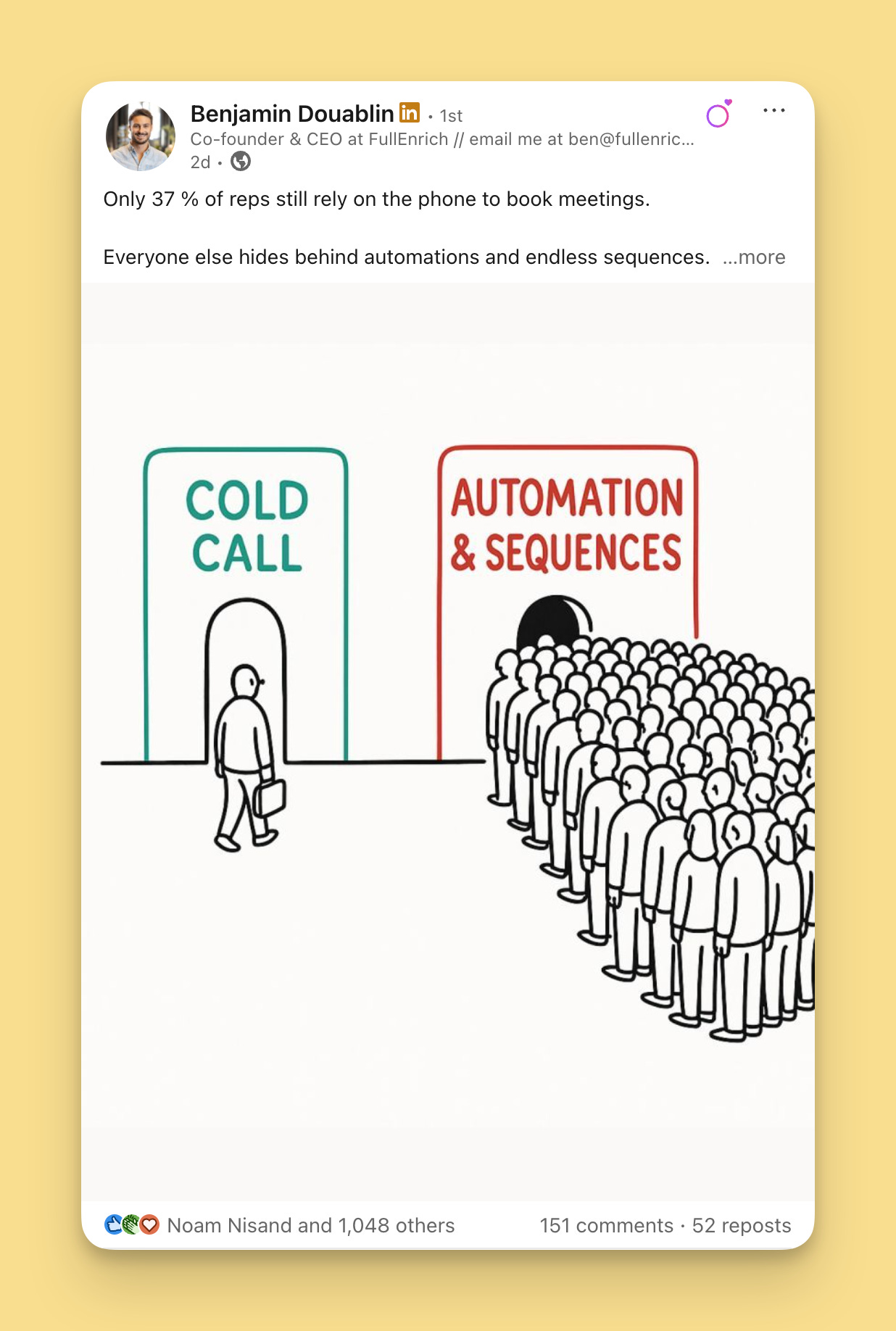
2. Only 37 % of reps still rely on the phone to book meetings.
Why this post?
Another post that went viral this week - it got 1k likes in 2 days and performed 8-23 times better than Benjamin’s previous content.
WHY THIS POST WENT VIRAL
This post goes against the current “automate everything” trend in sales. It tells people that the old-school, uncomfortable thing actually works better - and most people are too soft to do it.
BREAKDOWN:
Stat hook: “Only 37% of reps still rely on the phone“ - specific number grabs attention and sets up the contrast
Creates two camps: Cold callers vs everyone hiding behind automation - forces readers to pick a side
Reframes the hard thing as an edge: Most people avoid cold calls - that’s exactly why it works
Simple action steps: “Pick up the phone. Hit 50 dials. Repeat tomorrow.” - no complexity, just do it
Us vs them energy: “They play it safe. You play to win.” - tribal, motivating
Core insight: “Cold calling is hard. That is why it works.” - simple truth that reframes difficulty as advantage
TRY THIS
Use a specific stat to set up your argument
Frame the hard or unpopular path as the competitive advantage
Create clear “us vs them” energy - make readers want to be in your camp
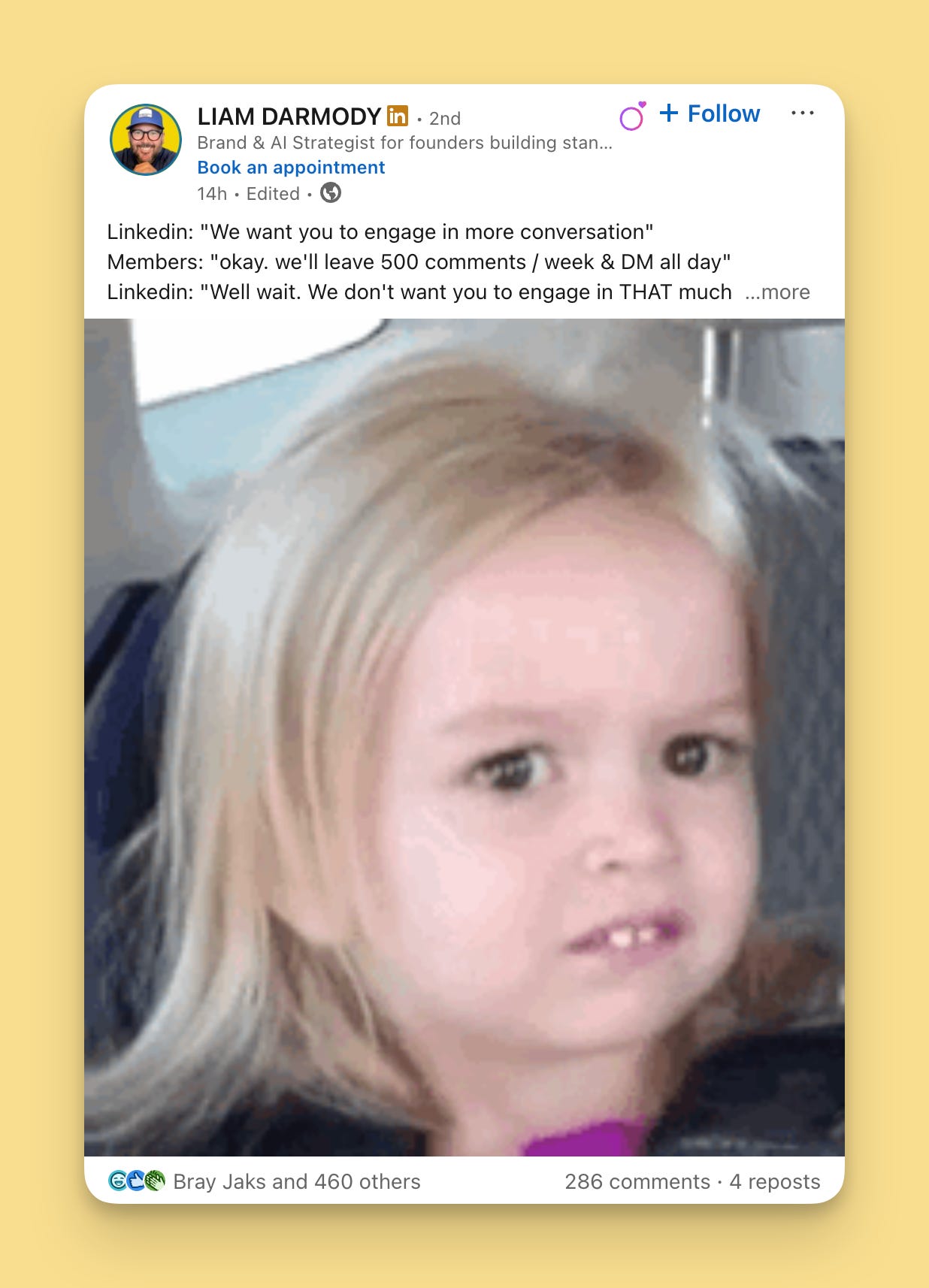
3. Linkedin: “We want you to engage in more conversation”
Why this post?
This post got 4-8 times more comments than Liam’s other posts this week.
WHY THIS POST WENT VIRAL
Everyone who posts on LinkedIn has felt this exact confusion. The platform tells you to engage, then flags you for engaging too much. It tells you to post consistently, but ghosting kills your reach.
BREAKDOWN:
Dialogue format: Uses a fake conversation between “LinkedIn” and “Members” - feels like a comedy sketch
Highlights absurdity: Shows LinkedIn giving contradictory advice - engage more, but not too much, but don’t ghost either
Perfect meme choice: The confused little girl image matches the tone exactly - everyone knows this meme
TRY THIS
Use dialogue format to show absurd or contradictory situations
Call out frustrations your audience secretly feels but hasn’t articulated
Pick a meme that matches the emotional tone of your message
LinkedIn Guide
The Re-Hook Method: why your second line matters more than your first
Everyone’s obsessed with hooks.
“Write better hooks!”
“Your hook is everything!”
“No hook = no engagement!”
Yeah, yeah. We get it.
But here’s what nobody tells you:
A great hook with a weak second line is like a movie trailer that’s better than the movie.
People click. Then they bounce.
I studied Jasmin Alic‘s content this week. He’s got 340K+ followers and is ranked #1 copywriter on LinkedIn.
And he says hooks alone won’t save your posts.
His secret? The “re-hook.”
Let me explain.
What’s a Re-Hook?
Simple.
The hook gets you in the room.
The re-hook slams the door behind you.
Most people write a killer first line. Then line 2 is... generic. Boring. Safe.
And the reader leaves.
Jasmin’s approach:
Line 1 = grab attention (the hook)
Line 2-3 = crush objections and make a promise (the re-hook)
Your re-hook should make people think: “Okay wait, now I HAVE to read this.”
Why This Matters on LinkedIn
Here’s the thing.
LinkedIn shows different amounts of text depending on your device:
Mobile (text only): 2-3 lines visible
Desktop (text only): 3 lines visible
Mobile with image: 1-2 lines
Desktop with image: 2 lines
So before anyone clicks “see more”... they only see your hook AND your re-hook.
If line 2 doesn’t deliver? They scroll.
Your re-hook is literally the make-or-break moment.
Bad vs. Good Re-Hooks
Let me show you the difference.
BAD:
“I want to share some thoughts about leadership.”
(Cool. So does everyone. Moving on.)
GOOD:
“I got fired on a Monday.
Best decision my boss ever made.”
See how line 2 flips it? Now you’re curious.
Another one.
BAD:
“Networking changed my life.
Here are some tips.”
(Boring. Predictable. Dead.)
GOOD:
“Networking changed my life.
But not in the way the LinkedIn gurus told me it would.”
Now there’s tension. There’s a story. You want to know what happened.
The Re-Hook Formula
Here are 3 ways to write re-hooks that lock people in:
Flip the expectation
Hook: “I applied to 1,600 jobs on LinkedIn.”
Re-hook: “Only won 1.”
You expect a success story. The re-hook says “nope, this is about failure.” Instant curiosity.
Add a “but” or “twist”
Hook: “I made $10K last month.”
Re-hook: “But I almost quit the week before.”
The twist creates tension. People need to know what happened.
Make a specific promise
Hook: “Stop wasting time on hooks.”
Re-hook: “Here’s the 3-line formula that gets me 1M+ views.”
Specific numbers. Clear outcome. People know exactly what they’re getting.
How to Practice This
Next time you write a post, do this:
Write your hook (line 1)
Write 3 different re-hooks (lines 2-3)
Pick the one that creates the most “wait, what?” reaction
Read lines 1-3 out loud. Would YOU click “see more”?
If the answer is “meh”... rewrite the re-hook.
The hook opens the door.
The re-hook locks them in.
Nail both = people actually read your stuff.
Quick Homework
Go look at your last 3 posts.
Read only the first 2-3 lines.
Ask yourself: “Does line 2 make me want to keep reading? Or is it just... there?”
If it’s just there, now you know why engagement was low.
It wasn’t your hook.
It was your re-hook.
That’s it for this week.
Go fix your second lines. They’re doing more damage than you think.
See you next time.
That’s a wrap for today.
See you next week! If you want more LinkedIn tips, be sure to follow me on LinkedIn (link).
If you love this episode and want to support us, spread the word about us by sharing The LinkedIn Secrets with colleagues. I really appreciate it!
Thank you for reading!
What’d you think of today’s edition?
Help me to understand what you think about this episode. Just reply with a number (1, 2, or 3) to this email.
1 - Damn good
2 - Meh, do better
3 - You didn’t cook it
Your compadre,
Anton “LinkedIn growth strategies” Cherkasov
bagusnya