

Hi there,
I study what makes LinkedIn posts go viral, so you can write content that connects.
In this issue, you’ll find:
The 3 high-performing LinkedIn posts this week
Why your LinkedIn content gets 0 leads (and how to fix it)
The 3 high-performing posts this week
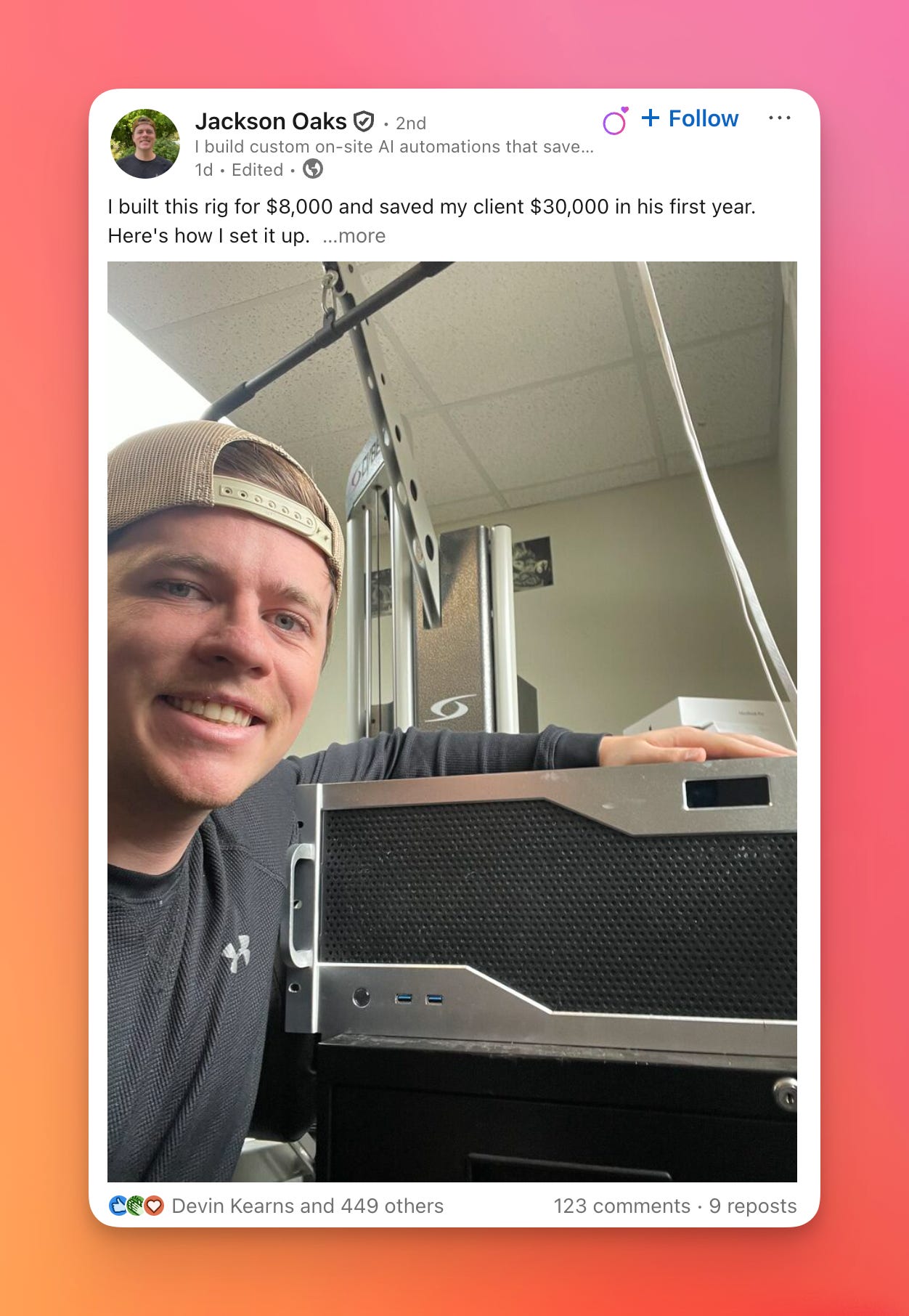
1. I built this rig for $8,000 and saved my client $30,000 in his first year.
Why this post?
This post went viral, receiving 450k likes in a day. It received 5-50 times more engagement and views than Jackson’s posts this week.
WHY THIS POST WENT VIRAL
This post showed a real alternative to expensive AI subscriptions that most businesses don’t know exists.
BREAKDOWN
ROI hook: “I built this rig for $8,000 and saved my client $30,000 in his first year“ - immediate value proposition
Setup promise: “Here’s how I set it up” - creates curiosity about the technical process
Solution discovery: “I found an open source model that, with the right setup, could perform the same task“
Stack breakdown: TensorRT-LLM for inference, ngrok for web API, RAG database for context
Cost comparison: $400/month power bill vs $2,500/month subscription - massive savings
Proof photo: Selfie with the actual custom-built rig - shows it’s real, not theoretical
TOGETHER WITH POSTHERO
Grow your audience faster on LinkedIn. With an AI-powered tool that helps you create content and grow on LinkedIn.
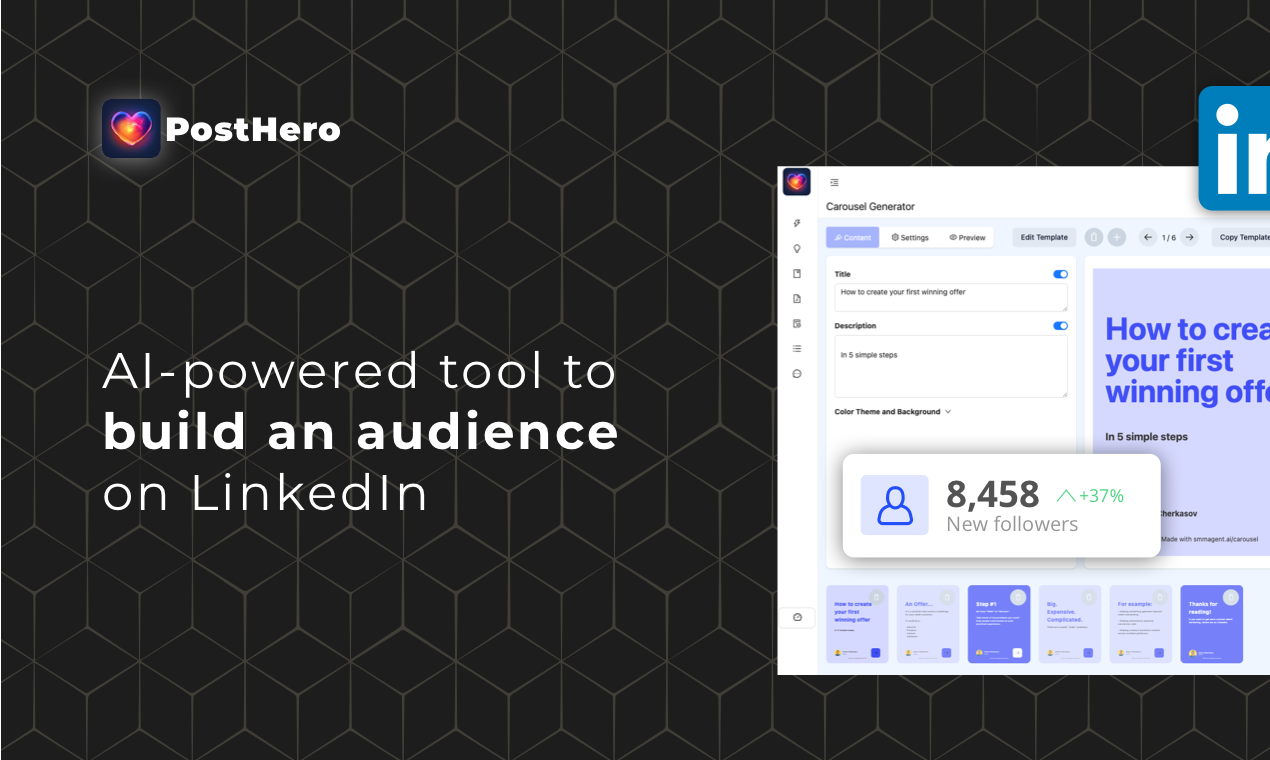
Create high-converting content that helps you grow on LinkedIn
Create a weekly content in 76 seconds
AI Voice assistant for creating content in seconds
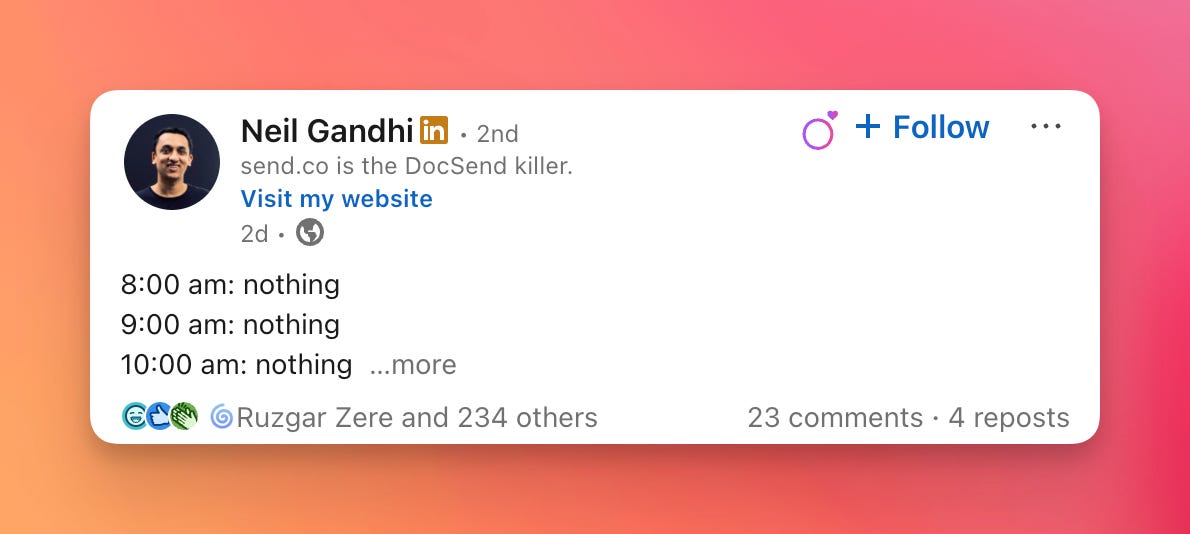
2. 8:00 am: nothing
Why this post?
Another post that went viral this week—it got 234 likes in 2 days and performed 5-10 times better than Neil’s previous content.
WHY THIS POST WENT VIRAL
This post nailed the universal founder experience: spending all day waiting for customer activity, then getting slammed the second you try to step away.
BREAKDOWN:
Repetitive schedule: Lists hourly timeline of “8:00 am: nothing, 9:00 am: nothing, 10:00 am: nothing...“ creating rhythm
Relatable humor: Captures the founder experience of waiting for work, then getting buried instantly
Minimalist format: No explanation needed - the timeline tells the whole story
Murphy’s Law joke: Work only appears when you’re about to take a break
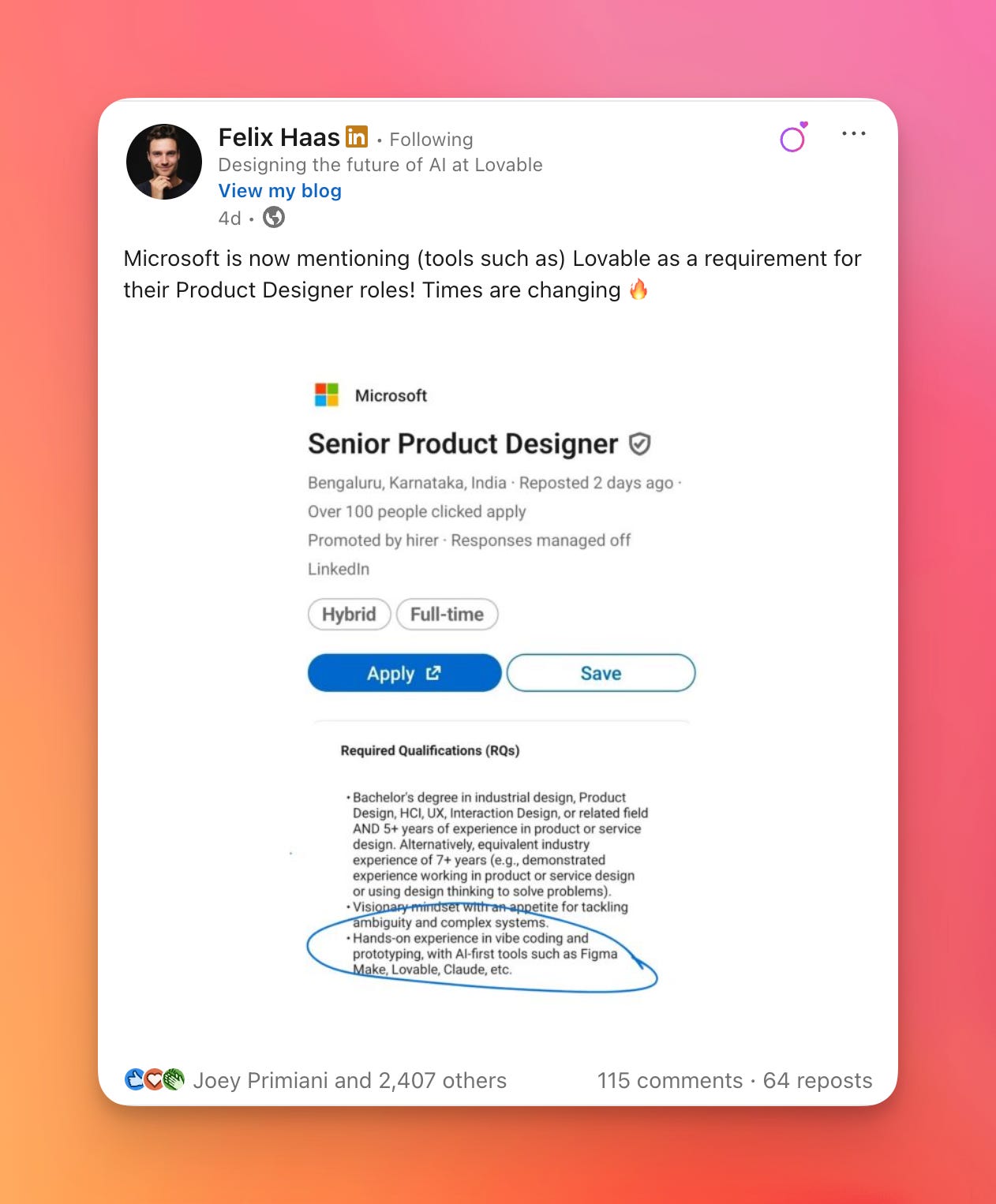
3. Microsoft is now mentioning
Why this post?
This post got 2.5-13 times more comments than Felix’s other posts this week.
WHY THIS POST WENT VIRAL
This post shows the power of documenting small wins on the journey.
BREAKDOWN:
Screenshot proof: Shows actual Microsoft job posting with Lovable circled in requirements
No long explanation: Just the fact and the evidence - lets the achievement speak for itself
Build in public moment: Shares the win with his audience who’ve been following the journey
Simple format: Text + screenshot - no need for fancy design or long story
LinkedIn Guide
Why your LinkedIn content gets 0 leads (and how to fix it)
I posted on LinkedIn 3 times per week about trends for 6 months.
Good engagement. Comments rolling in. Profile views increasing.
Total qualified leads generated: 0.
Then I changed my content strategy and started getting 10-20 qualified leads per month.
Here’s what I learned: Engagement and leads are two completely different games. Most founders are playing the wrong one.
The Lead Generation Problem
What most founders celebrate:
Posts getting hundreds of likes
High engagement rates
Growing follower count
Viral content
Why this doesn’t generate leads:
Engagement ≠ business interest
Likes come from browsers, not buyers
Viral content often attracts the wrong audience
The reality: You can have amazing engagement and zero pipeline. Or low engagement and full calendar.
The 5 Reasons Your Content Gets Zero Leads
Reason #1: You’re Creating Content for Engagement, Not Conversion
The problem: You optimize for what gets likes, not what generates business.
Content that gets high engagement:
“5 lessons I learned as an entrepreneur”
“Why I quit my 6-figure job”
“Morning routines of successful founders”
Who engages: Other founders, aspiring entrepreneurs, content creators
Content that generates leads:
“How we reduced customer churn from 18% to 6% in 90 days”
“Why B2B SaaS companies see support tickets spike 200% after product updates”
“The onboarding mistake costing you $50K/year in support costs”
Who engages: Founders with churn problems, VPs dealing with support issues, decision-makers with budgets
Example transformation:
Before (0 leads): “10 productivity hacks that changed my life”
After (6 leads): “Our SaaS onboarding completion rate was 23%. Industry average is 60%. We assumed our onboarding was too complicated. Wrong. The real problem: asking for 47 fields upfront when users only needed 12...”
Why this works: Hyper-specific problem = only people with that problem engage = qualified leads.
Reason #2: No Clear Problem-Solution Connection
The problem: Your content doesn’t make prospects realize they have a problem you can solve.
What most founders post:
Generic business advice
Industry trends without application
Company milestones
Personal stories without business lesson
Why this fails: No connection between content and what you actually do.
The fix: Every Post Needs This Structure
Identify specific problem your ICP has
Show the cost/impact of that problem
Hint at how you approach solving it
Make them want to know more
Example:
Post without connection (0 leads): “Just closed an amazing quarter! Our team hit 150% of the target. So proud of everyone! 🚀”
Post with connection (generates leads): “Our sales team hit 150% of quota this quarter.
Not because we hired more reps. We went from 8 to 6 reps.
The change: [change]
New rule: [new rule]
Result: [result]
The lesson: [lesson]”
Why the second works: Shows problem, shares approach, makes them self-identify.
Reason #3: You’re Jumping Straight to Solutions
The problem: You talk about your solution when your audience doesn’t even know they have a problem.
What most founders do: Post only about: “Here’s how our product works” or “Why you should use [solution]”
Why this fails: 90% of your audience isn’t ready to buy yet.
The fix: The 70-20-10 Content Mix
70% Problem Awareness: Make them realize the problem exists or is worse than they thought.
“If your support tickets increased 40% this year despite improving your product, you don’t have a support problem. You have a discoverability problem...”
20% Solution Education: Show different approaches to solving the problem.
“We tried 3 approaches to reduce support tickets:
Better documentation (tickets up 5%)
Help center redesign (down 3%, then back up)
Contextual guidance (down 65%)
Here’s why only #3 worked...”
10% Product/Service: Specific case studies or results.
“How we helped [Company] reduce support tickets from 400/week to 140/week in 60 days...”
Why this works: Builds awareness → educates → converts naturally.
Reason #4: No Call-to-Action or Next Step
The problem: People engage with your content but have no idea how to work with you.
The fix: The Soft CTA Strategy
Don’t do this: “Book a call: [calendar link]”
Do this instead:
The Qualification Question: “Any B2B SaaS founders seeing support tickets spike despite product improvements?”
The Lead Magnet: “I created a support cost calculator. DM me ‘CALCULATE’ and I’ll send it over.”
The Open Invitation: “If you’re spending $200K+/year answering the same customer questions, happy to share what worked for us.”
The Diagnostic: “If your customers engage in month 1 then disappear in month 2, you don’t have a retention problem. You have a value delivery problem. (Comment if this sounds familiar)”
Why these work: Low friction, high qualification, natural conversation starter.
Reason #5: You Post and Disappear
The problem: You publish content but don’t engage strategically with commenters.
What kills leads:
Never responding to comments
Generic “thanks!” responses
Not checking if commenters are in your ICP
No follow-up after engagement
The fix: The 24-Hour Engagement System
Hour 1: Respond to every comment with additional value.
❌ “Thanks! About 60 days.”
✅ “About 60 days, but we saw leading indicators in 2 weeks. The key was tracking daily active usage, not retention metrics. The specific triggers we watched: [X, Y, Z]. Happy to share the framework if it is useful.”
Hours 2-24: Check commenters’ profiles:
In your ICP? → Engage with their content
Showing buying signals? → Build relationship
Asked a detailed question? → Take to DMs
Example DM (1 week later): “Hey [Name], saw your comment on my post about [topic]. You mentioned [a specific thing]. Curious - are you currently dealing with [related problem]? I wrote a deeper breakdown that might help.”
Result: When they need help, you’re top of mind.
The Content Audit for Leads
Review your last 10 posts:
Does each address a specific problem your ICP has?
Would only your ideal customer care about this?
Does it connect to what you actually sell?
Is there a clear next step for interested prospects?
Are commenters in your ICP or random scrollers?
Score:
8-10 yes: Optimized for leads
5-7 yes: Needs optimization
0-4 yes: Optimized for engagement, not leads
The Lead Generation Content Formula
Hyper-Specific Problems (only ICP relates) + Problem-Solution Bridge (connects to what you sell) + 70-20-10 Mix (awareness before solutions) + Soft CTAs (questions, not calendar links) + Strategic Engagement (build ICP relationships) = Content that generates qualified leads
Stop chasing likes. Start tracking conversations.
That’s a wrap for today.
See you next week! If you want more LinkedIn tips, be sure to follow me on LinkedIn (link).
If you love this episode and want to support us, spread the word about us by sharing The LinkedIn Secrets with colleagues. I really appreciate it!
Thank you for reading!
What’d you think of today’s edition?
Help me to understand what you think about this episode. Just reply with a number (1, 2, or 3) to this email.
1 - Damn good
2 - Meh, do better
3 - You didn’t cook it
Your compadre,
Anton “LinkedIn growth strategies” Cherkasov