

Hi there,
I analyze what makes LinkedIn posts go viral, so your content gets noticed.
In this issue, you’ll find:
The 7-step playbook that fits on a sticky note (and the real work hiding under each step)
Why “hard” is actually the best news you’ll hear about LinkedIn
TOGETHER WITH POSTHERO
Grow your audience faster on LinkedIn. With an AI-powered tool that helps you create content and grow on LinkedIn.
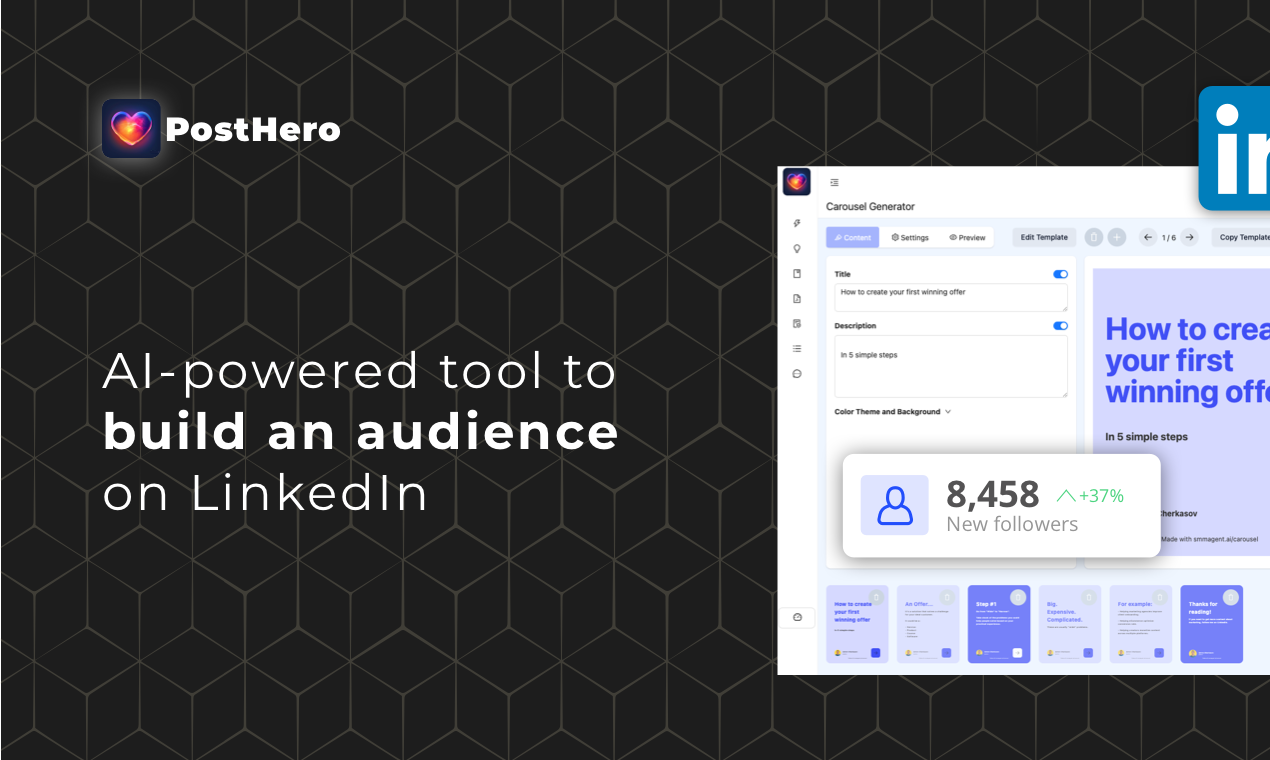
Create high-converting content that helps you grow on LinkedIn
Create a weekly content in 76 seconds
AI Voice assistant for creating content in seconds
LinkedIn Is Simple. It’s Just Not Easy.
Here’s a promise you’ve heard a thousand times:
“LinkedIn is easy. Just post consistently and you’ll grow.”
It’s everywhere. Some guru tells you the steps, makes it sound effortless, and you think “okay, I can do that.”
Then you try. And it’s hard. And you get discouraged. And you quit.
Sound familiar?
Here’s what nobody tells you:
LinkedIn is simple. But it’s not easy.
Those are two completely different things. And confusing them is exactly why most people give up.
Let me explain the difference. Because once you get it, you’ll stop feeling like you’re failing.
Simple vs. Easy
These words get used like they mean the same thing. They don’t.
Simple means the steps are clear. Not complicated. Easy to understand.
Easy means it takes little effort. You can do it without much struggle.
Something can be simple and hard at the same time.
Losing weight is simple: eat less, move more. But it’s not easy. If it were, everyone would be in shape.
Building a business is simple: solve a problem people will pay for. But it’s not easy. If it were, everyone would be rich.
LinkedIn is the same.
The steps are simple. Anyone can understand them. But doing them, week after week, for months and years? That’s hard.
And that’s fine. It’s supposed to be.
The “Simple” Version of LinkedIn
Let me give you the whole playbook. The simple version.
Here’s everything you need to do to win on LinkedIn:
Show up regularly with posts
Comment with a purpose, not just to be seen
Improve your writing over time
Build something people actually want to buy
Move conversations into DMs and onto calls
Build a small audience that genuinely trusts you
Pick one thing and get known for it
That’s it. That’s the entire game.
Seven things. Clear. Simple. Nothing complicated about any of them.
You could write them on a sticky note.
So why isn’t everyone crushing it?
Because simple doesn’t mean easy.
Let’s look at what each of these actually requires.
What “Simple” Actually Demands
Read the list again. Now look at what’s hiding behind each point.
“Show up regularly with posts”
Simple to say. But it means showing up when you’re tired. When you have no ideas. When the last post flopped. When nobody seems to care. For months before it clicks.
That’s not easy. That’s discipline.
“Improve your writing over time”
Simple to say. But it means writing badly for a long time. Studying what works. Rewriting hooks over and over. Slowly, painfully improving.
That’s not easy. That’s practice.
“Build something people actually want to buy”
Simple to say. But it means getting brutally clear on who you help and how. Testing. Failing. Refining. Positioning yourself in a crowded market.
That’s not easy. That’s thinking hard about hard things.
“Move conversations into DMs and onto calls”
Simple to say. But it means putting yourself out there. Getting ignored. Getting rejected. Having awkward conversations. Doing it anyway.
That’s not easy. That’s courage.
See the pattern?
Every “simple” step hides real work underneath it.
3 Things It All Requires
Every single thing on that list demands three ingredients:
Time. None of this works overnight. It compounds over months and years. You have to keep going long before you see results.
Effort. Real work. Showing up. Doing the reps even when you don’t feel like it. Especially then.
Talent. Not natural-born genius. But skill you build over time. Writing, positioning, selling, connecting. These are learnable, but learning them takes work.
Time, effort, talent.
That’s the price. And there’s no way around paying it.
The steps are free to know. But executing them costs you.
Why 98% Never Even Start
Here’s the sad part.
Over 98% of LinkedIn users don’t post actively. Ever.
Why?
Because they were told it’s easy.
They heard “just post consistently and you’ll grow.” They tried it for two weeks. It was harder than promised. Results didn’t come fast. And they thought “this doesn’t work” or “I’m not good at this.”
So they quit.
But the problem was never them. The problem was the lie that it would be easy.
If someone had told them the truth, “this is simple but it’s going to be hard, and that’s normal,” they might have stuck around.
Expectations are everything. When you expect easy and get hard, you feel like a failure. When you expect hard and get hard, you feel like you’re on track.
Same difficulty. Completely different outcome.
Why “Hard” Is Actually Good News
Now here’s the reframe that changes everything.
The fact that it’s hard is the best thing about it.
Think about it.
If LinkedIn were easy, everyone would do it. And if everyone did it, it would be worthless. No advantage. No edge. Just noise.
The difficulty is the moat.
Because most people quit, the ones who stay win. Not because they’re smarter. Because they endured.
Every time it feels hard and you keep going, you pull ahead of the 98% who stopped.
The hard part isn’t the obstacle. It’s the whole point.
If it’s easy for everyone, it’s probably not worth much. The stuff worth having is always a little hard to get.
So when it feels difficult, don’t take it as a sign you’re failing. Take it as a sign you’re doing something most people can’t.
What This Means for You
Stop waiting for it to feel easy. It won’t.
Stop thinking something’s wrong because it’s hard. Nothing’s wrong. Hard is the deal.
Instead, do this:
Lower your expectations on speed. Raise them on effort.
You’re not going to blow up in a month. But if you put in real work consistently, you’ll get there.
Judge yourself on inputs, not outputs.
You can’t control the algorithm or who follows you. You can control whether you showed up and did the work. Measure that.
Play longer than the quitters.
You don’t have to be the most talented. You just have to still be here when everyone else gave up. That alone puts you in the top few percent.
Simple steps. Hard execution. Long timeline.
That’s the honest version nobody sells you. Because “it’s hard but worth it” doesn’t make for a catchy hook.
But it’s the truth. And knowing it is what’ll keep you going when the easy-promisers have all burned out.
The Bottom Line
LinkedIn is simple.
Publish consistently. Engage with people. Improve your writing. Create an offer. Talk to people. Build community. Be known for one thing.
You already know what to do. It was never a secret.
But knowing isn’t the hard part. Doing is.
So don’t get discouraged when it’s hard. Getting discouraged is what the 98% did. And look where it got them.
The steps are simple. The work is hard. The reward is real.
Now go do the hard thing.
Your Homework
This week, do this:
Look at the 7-step list. Be honest: which ones are you actually doing? Which are you avoiding because they’re hard?
Pick the hardest one. The one you keep dodging. That’s probably the one holding you back.
Do it this week anyway. Not perfectly. Just do it.
Notice the feeling of doing something hard. That discomfort is you pulling ahead of the people who quit.
Remember: you don’t have to be the best. You just have to still be here.
LinkedIn was never easy.
It was just always worth it.
That’s it for this week.
If you’ve been feeling like LinkedIn is hard, reply and let me know you’re still in it. You’re closer than you think.
See you next time.
That’s a wrap for today.
See you next week! If you want more LinkedIn tips, be sure to follow me on LinkedIn (link).
If you love this episode and want to support us, spread the word about us by sharing The LinkedIn Secrets with colleagues. I really appreciate it!
Thank you for reading!
What’d you think of today’s edition?
Help me to understand what you think about this episode. Just reply with a number (1, 2, or 3) to this email.
1 - Damn good
2 - Meh, do better
3 - You didn’t cook it
Your compadre,
Anton “LinkedIn growth strategies” Cherkasov