

Hi there,
I uncover the LinkedIn strategies that turn profiles into client-generating machines.
In this issue, you’ll find:
The 4 signs your offer is the real problem (not your hooks or the algorithm)
The 10-second test that tells you if your offer actually converts
TOGETHER WITH POSTHERO
Grow your audience faster on LinkedIn. With an AI-powered tool that helps you create content and grow on LinkedIn.
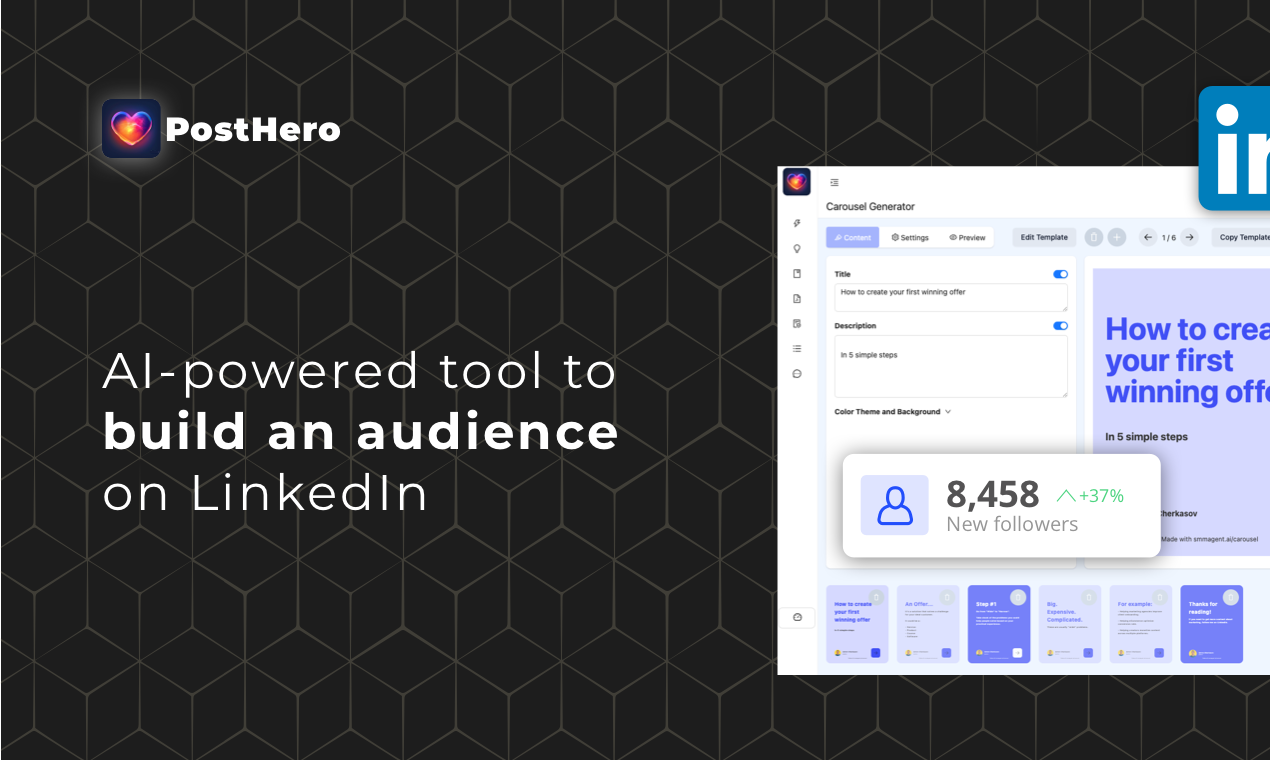
Create high-converting content that helps you grow on LinkedIn
Create a weekly content in 76 seconds
AI Voice assistant for creating content in seconds
Your Content Isn’t the Problem. Your Offer Is.
You’ve been grinding.
Better hooks. More posts. Commenting every day. Optimizing your profile. Showing up consistently.
And your reach is up. People are seeing your stuff. Profile views are climbing.
But the clients still aren’t coming.
So you assume you need more. More reach. More followers. More engagement. You double down on content.
Here’s the hard truth:
More visibility won’t fix a weak offer.
You can send a thousand people to your profile. If your offer doesn’t land, none of them convert. You’re just pouring more water into a leaky bucket.
I learned this the hard way. And most creators never learn it at all.
Today we fix the bucket.
The Trap Everyone Falls Into
Almost everyone builds their LinkedIn strategy backwards.
They obsess over the top of the funnel. Impressions. Likes. Comments. Follower count.
They treat visibility as the goal.
But visibility isn’t the goal. Conversion is.
And conversion happens when the right person lands on your profile, understands what you offer, and thinks “yes, I need that.”
If that last part is broken, everything upstream is wasted.
You could go viral tomorrow. If your offer is weak, you’d get a spike in followers and zero new clients.
More impressions can’t save an offer that doesn’t convert a single profile visitor.
The order matters. Offer first. Visibility second.
Why This Order Matters So Much
Think of it like this.
Your content drives traffic. Your offer converts it.
If you fix the traffic but not the conversion, you get lots of visitors and no customers.
If you fix the conversion first, then every bit of traffic you add actually turns into something.
This is why some people with small audiences out-earn people with huge ones.
The small-audience person nailed their offer. Every visitor counts. The big-audience person has a fuzzy offer. Most visitors bounce.
Same traffic. Wildly different results.
The offer is the multiplier. Get it right, and everything else you’re already doing suddenly works harder.
What “A Weak Offer” Actually Looks Like
Let’s get specific. Here’s how you know your offer is the problem.
It’s vague.
“I help businesses grow.”
Grow how? Which businesses? Grow what exactly?
Nobody reads that and thinks “that’s for me.” It’s too broad to mean anything.
It’s about you, not them.
“I’m a passionate consultant with 10 years of experience offering strategic solutions.”
Cool. But what do I get? What problem of mine do you solve?
People don’t care about your experience. They care about their outcome.
It has no clear outcome.
“I offer coaching and consulting services.”
Services to do what? Get me where?
If there’s no clear result attached, there’s no reason to buy.
It’s trying to serve everyone.
“I work with startups, enterprises, solopreneurs, and agencies across all industries.”
When you serve everyone, you speak to no one.
The broader your offer, the weaker it hits.
If any of these sound like your profile, your content was never the issue.
What A Strong Offer Looks Like
A strong offer is clear, specific, and outcome-focused.
The formula is simple:
I help [specific person] achieve [specific outcome] through [specific method].
Compare these:
Weak: “I help businesses with marketing.”
Strong: “I help B2B founders book 5-10 sales calls a month with LinkedIn content.”
Weak: “I offer career coaching.”
Strong: “I help mid-career engineers land senior roles without applying to a single job board.”
Weak: “I’m a fitness coach.”
Strong: “I help busy dads lose 20 pounds in 90 days without giving up beer or weekends.”
See the difference?
The strong ones are specific. You know exactly who it’s for and what you get.
The moment the right person reads it, they think “that’s me. I want that.”
That’s what converts.
The Three Questions Your Offer Must Answer
When someone lands on your profile, they’re silently asking three things.
Your offer needs to answer all three in seconds.
1. Is this for me?
They need to instantly recognize themselves.
“B2B founders” tells a B2B founder this is for them.
“Businesses” tells nobody anything.
Be specific about who you serve. The right people will feel it.
2. What do I get?
They need a clear outcome.
Not your process. Not your credentials. The result.
“Book 5-10 sales calls a month.” That’s a result I can picture. That’s something I want.
3. Why you?
They need a reason to trust you specifically.
This is where your content, your results, and your social proof come in. Client wins. Case studies. Your own story.
Answer these three and the conversion takes care of itself.
How Your Content and Offer Work Together
Here’s the part most people miss.
Your content and your offer aren’t separate things. They feed each other.
Your offer decides what you post about. And your content proves you can deliver on your offer.
If your offer is “I help founders book sales calls with LinkedIn content,” then your content should show you know exactly how to do that. Every post is evidence.
By the time someone reads your offer, your content has already convinced them you’re the real deal.
Content builds trust. The offer closes the loop.
But it only works if the offer is clear enough to build content around. A fuzzy offer gives you fuzzy content. A sharp offer gives you sharp content.
Fix the offer, and your content gets easier to write too.
The Fastest Way to Test Your Offer
Want to know if your offer is strong?
Try this.
Show your profile headline and About section to someone who doesn’t know what you do.
Give them 10 seconds. Then ask:
“Who do I help, and what result do I get them?”
If they can answer clearly, your offer works.
If they hesitate, or guess wrong, or say “I’m not sure,” your offer is the problem.
Not your content. Not the algorithm. The offer.
This 10-second test will teach you more than a month of tweaking hooks.
Before You Chase More Reach
I’m not telling you to stop creating content.
Keep posting. Keep commenting. Keep showing up.
But before you pour more energy into getting more eyeballs, make sure those eyeballs land on something worth converting.
Fix the offer first. Then all the visibility work you’re already doing starts paying off.
It’s the difference between adding traffic to a leaky funnel and adding traffic to one that actually converts.
Same effort. Completely different results.
Get the offer right, and you might find you don’t even need more reach. You just needed the reach you already had to actually work.
Your Homework
This week, do this:
Write your current offer in one sentence. Who you help, what result, how.
Run the 10-second test. Show it to someone who doesn’t know your work. Ask them who you help and what they get.
If they can’t answer clearly, rewrite it. Use the formula: I help [specific person] achieve [specific outcome] through [specific method].
Update your headline and About section to match.
Then, and only then, go back to creating content.
Stop blaming your content for a problem your offer is causing.
Fix the offer. Watch everything else finally click.
That’s it for this week.
If you rewrite your offer this week, reply and send me the new version. I’ll tell you if it passes the test.
See you next time.
That’s a wrap for today.
See you next week! If you want more LinkedIn tips, be sure to follow me on LinkedIn (link).
If you love this episode and want to support us, spread the word about us by sharing The LinkedIn Secrets with colleagues. I really appreciate it!
Thank you for reading!
What’d you think of today’s edition?
Help me to understand what you think about this episode. Just reply with a number (1, 2, or 3) to this email.
1 - Damn good
2 - Meh, do better
3 - You didn’t cook it
Your compadre,
Anton “LinkedIn growth strategies” Cherkasov